
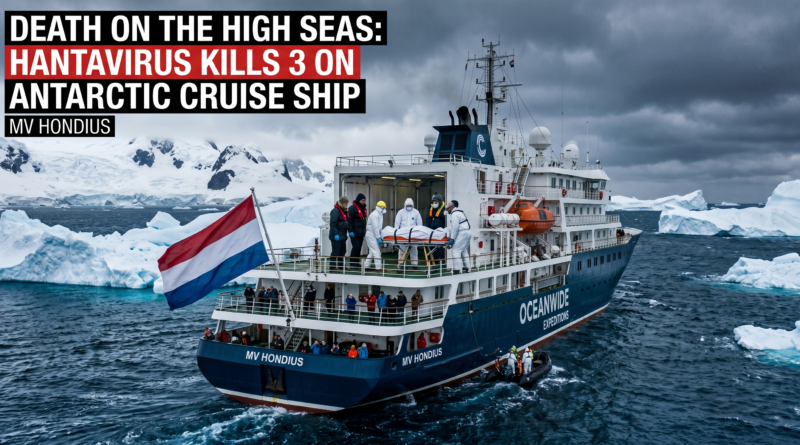
Death on the High Seas: Hantavirus Kills 3 on Antarctic Cruise Ship
Picture taking the vacation of a lifetime on a luxury Antarctic expedition cruise, pristine icebergs, remote islands, and some of the most isolated areas of the deep sea on earth. Now, suppose that this dream becomes a nightmare that no one could have foreseen. That’s what happened in April 2026 on the MV Hondius, when the world was stunned, and three passengers died in the middle of the Atlantic Ocean of a deadly outbreak of hantavirus.
This is not a horror story from the fiction world. It is real, it is happening, and it calls into question cruise ship disease outbreaks, the risks of remote traveling, and just how ready the world is when a killer virus infects somewhere you cannot quickly get away.
What Happened Aboard the MV Hondius?
MV Hondius is a Dutch cruise ship, owned by Oceanwide Expeditions, and is regarded as an expedition-class ship. It’s the type of vessel that services high-end adventurers willing to pay from €14,000 to €22,000 a berth to go once in a lifetime to the Antarctic. The ship set sail from Ushuaia, Argentina, in the southernmost tip of Patagonia, carrying approximately 150 passengers and crew from 23 countries on April 1, 2026.
After five days on the journey, a 70-year-old Dutch passenger started to feel ill. Fever, headache, and diarrhoea symptoms, which might be confused with a stomach bug or fatigue. By April 11, however, the very same passenger had died, suffering from severe respiratory problems somewhere in the distant South Atlantic, between South Georgia and St. Helena.
What followed was a slow-moving, terrifying crisis at sea.
The victim’s wife later traveled to South Africa as the man’s wife. She died two days after arriving in St. Helena at the hospital on April 24, after collapsing at the airport in Johannesburg. Another passenger, a German woman, died on board a cruise ship weeks later, and it became official: It was a hantavirus cruise ship outbreak.
When the WHO officially declared the outbreak, the ship was stuck off the coast of Cape Verde and diverted from the Canary Islands because the regional president didn’t want to spread the virus to locals. Spain finally granted permission to dock in Tenerife on humanitarian and international law grounds, and by early May, over 140 remaining passengers were sent home.
What Is Hantavirus, and Why Is the Andes Strain So Alarming?
Most people are aware of hantavirus in passing from news reports about people who got the infection when they cleaned out a dusty shed or slept in a room that was infested with rodent droppings. Hantaviruses are zoonotic viruses, which means they are naturally found in rodents and rarely infect humans. The deadliest is hantavirus pulmonary syndrome (HPS) in the Americas, a serious respiratory illness that can be fatal within a short period of time.
The strain of this hantavirus cruise ship outbreak is not the ordinary hantavirus. That’s the Andes virus, and that is a big deal.
Why the Andes Virus Is Uniquely Dangerous
The Andes virus has a sad legacy; it is the only known strain of hantavirus that can infect people. All other types need to come in direct contact with infected rodents or their urine, droppings, and saliva. The Andes virus is, however, more likely to be transmitted from person-to-person via prolonged contact with respiratory secretions or bodily fluids from an infected person.
This hantavirus spread on a cruise ship is so alarming and so hard to contain because it is a human-to-human spread in the first place. Hundreds of people live in the same rooms, and the food is consumed in close quarters with recycled air.
The death rate for those who end up with full respiratory symptoms of HPS is about 38%, according to the CDC. The case fatality rate in historical clusters of Andes virus outbreaks is as high as 50%, according to the WHO.
This isn’t a mild illness. It can be lethal, and it can be deadly quick.
A Timeline of the Hantavirus Outbreak at Sea
Here’s the timeline of the MV Hondius hantavirus tragedy in 6 devastating weeks:
- April 1, 2026: MV Hondius leaves Ushuaia. There are no passengers exhibiting symptoms at departure, re but health officials later note that the virus incubation period is 4 to 42 days.
- After traveling for months in Argentina, Chile, and Uruguay, the 70-year-old Dutch man who went on the trip is stricken with fever, headache, and diarrhea on April 6.
- April 11: The Dutch passenger dies on board from acute respiratory failure. The cause of death is at first an unknown factor.
- The removal of the passenger’s body takes place in St. Helena on April 24. His wife gets off at the same island.
- April 26: The wife collapses at Johannesburg’s airport and is admitted to the hospital.
- A British passenger with serious symptoms is taken off Ascension on April 27. To the South African Island.
- On May 2, the WHO officially reported there was a cluster of severe acute respiratory illness on a cruise ship.
- May 4-6: MV Hondius docks at Cape Verde. The Canary Islands at first reject the ship. The German woman who has fallen ill on board dies and is the third casualty.
- May 6: Health officials in South Africa and Switzerland announce that the cases are all from the Andes virus. In Zurich, a Swiss patient is identified as having been infected. The Spanish central government permitted docking in Tenerife, despite initial regional concerns.
- On 8-9 May, WHO reports 8 total cases: 6 confirmed, 2 suspected, 3 deaths (a case fatality ratio of 38%). The response is a CDC level 3 emergency. Evacuation to home countries for passengers begins.
Hantavirus Symptoms: What to Watch For
Knowing the symptoms of hantavirus infection may save a life if you or someone you know was on board the MV Hondius or in close contact with anyone who was involved with the outbreak. This hantavirus cruise ship outbreak has made people aware of it throughout the world,d and the CDC recommends caution due to the incubation period for the virus.
Early-Stage Symptoms (Days 1–5)
- Fever and chills
- Sudden, severe muscle pain, particularly in the thighs, hips, back, and shoulders.
- Headache
- Lack of strength and energy
- Nausea, vomiting, diarrhea, and abdominal pain
- Dizziness
Late-Stage Symptoms (Days 4–10)
- Persistent cough
- Shortness of breath
- Fillings of the lungs with fluid (pulmonary edema)
- Rapid deterioration with need for oxygen support or mechanical ventilation
Agencies such as the UK Health Security Agency are still tracking passengers who disembarked anywhere on the route, including St Helena, as the symptoms can take up to 8 weeks to appear. CDC has advised healthcare providers throughout the United States to watch for imported cases, but has emphasized that the risk to the general public in the United States is very low.
How Does Hantavirus Spread on a Cruise Ship?
Everyone’s wondering this, and it is reasonable. Normally, one would not be concerned with being infected with hantavirus on a cruise. It’s not the flu. It does not spread in the air like COVID-19. It is found in rodents.
In fact, how did a hantavirus outbreak occur on a cruise ship in the first place?
The answer might be found in the index case, the Dutch passenger who had road tripped for four months across South America before getting on board. Argentine health authorities have since been trapping and testing rodents as he passed by in order to find the source of his initial infection. He is thought to have picked up the Andes virus on land before ever setting foot on the ship.
But once in the country, the Andes virus’s ability to spread from person to person did the rest. The virus spreads, not like wildfire, but was sufficient to infect many passengers and crew members over several weeks of close contact, shared space,e and prolonged exposure in the small quarters of a cruise ship.
The Andes Virus Spreads Person to Person
- Saliva or respiratory secretions from infected people
- Cross-contamination from an infected individual to another person’s food through shared utensils, dishes, or cups
- Touching an infected person’s body fluids or bedding.
- Kissing or any other intimate contact
Notably, transmission is not as easy as the transmission of a typical respiratory virus, as confirmed by the WHO. Close and continuous contact is usually required. Casual contact, as it were, will not likely result in infection.
The WHO Response and Global Health Alert
The World Health Organization (WHO) has played a key role in handling the consequences of this hantavirus outbreak on a cruise ship. In the lead-up to the ship’s arrival, WHO Director-General Tedros Adhanom Ghebreyesus flew down to Tenerife and delivered a message to the people of the island, promising all-out efforts to stop the spread from going further.
According to the official evaluation of the WHO, as of May 9, 2026, the risk of the outbreak spreading globally is low. They stress that the virus from the Andes has not been easily transmitted, and previous outbreaks indicate a limited spread even within the close contact circle. However, WHO has activated the international contact tracing network as per the International Health Regulations, and the national health focal points in various countries are tracing and monitoring individuals who may have been exposed.
The CDC, on its own, released a Health Alert Network alert to health care providers nationwide to be alert. There were also several passengers on the ship who were American citizens, including some who had already returned home before the outbreak was officially confirmed.
Is It Safe to Go on a Cruise? What Travelers Need to Know
It’s time to face the truth: you’re already asking yourself this question right now. It’s perfectly normal.
This hantavirus cruise ship outbreak is actually rare. Believe it or not, but demand for Antarctic cruises was already 34% higher than it was in the same period last year. Travel experts and global health officials are in general accord that this incident is a crisis of extreme proportions, a one-off case, a remote route, insufficient evacuation capabilities,s and the peculiar nature of the Andes virus.
That being said, there are some good takeaways to be had.
What Cruise Travelers Should Do Before They Book
- Research on medical boats. The high cost of the product does not mean that it has a high level of emergency infrastructure.
- Take out a detailed travel insurance policy. Be sure that policies offer at least $5,000,000 in medical evacuation coverage, particularly for remote locations.
- Know the risk profile of the country. Hantavirus exposure risk varies between areas endemic for the virus (such as parts of South America) and other areas.
- Be familiar with the evacuation procedure. When heading out to Antarctica or other remote locations, inquire with the operators about their emergency plans.
The MV Hondius hantavirus outbreak is a cautionary tale about the dangers of adventure travel. Being a responsible traveller means knowing the risks before travelling.
FAQs About the Hantavirus Cruise Ship Outbreak
Q1. What ship was affected by the hantavirus outbreak in 2026?
A1. The MV Hondius is a cruise ship owned by the Dutch firm Oceanwide Expeditions, which was the epicenter of the outbreak of the hantavirus among cruise ship passengers and crew in 2026. The vessel left Ushuaia, Argentina, on 1st April 2026.
Q2. How many people died from hantavirus on the cruise ship?
A2. As of May 9, 2026, three passengers died. WHO reported 6 confirmed and 2 suspected cases as of that date,e with 38% case fatality rate.
Q3. What type of hantavirus was on the MV Hondius?
A3. The Andes virus was first discovered by health officials in South Africa and Switzerland on May 6, 2026. Only one strain of the hantavirus is known to be able to be transmitted between human beings, the Andes virus.
Q4. Can hantavirus spread between people on a cruise ship?
A4. Close, prolonged contact with the saliva, respiratory secretions, or bodily fluids of an infected individual is the means by which the Andes virus can be transmitted. It is not as infectious as viruses spread through the air, such as COVID-19, bit ut was easily spread from person to person on a cruise ship.
Q5. Is there a treatment or vaccine for hantavirus?
A5. Specific antiviral therapy and an approved vaccine for hantavirus infection are not available. Patients benefit from supportive care (rest, fluid,s and assistance with their breathing), and prompt medical intervention is important for survival.
Q6. What is the WHO saying about this hantavirus outbreak?
A6. WHO has rated the public risk globally as low, as the Andes virus is not easily transmitted beyond close contacts. CDC upgraded its classification of the outbreak to Level 3 and published a Health Alert Network advisory for U.S. clinicians.
Q7. Should I cancel my cruise because of the hantavirus outbreak?
A7. Experts and travel guides around the world have stated that the danger to the majority of cruise passengers remains very low. But individuals travelling on an expedition cruise from a long distance should check out medical evacuation and onboard medical facilities, as well as have strong travel insurance.
Final Thoughts: A Tragedy That Changed How We Think About Remote Travel
Three people lost their lives. Families were shattered. A dozen passengers were left in their cabins on the ship, awaiting rescue for weeks, like early COVID-19. By all standards, it’s a tragedy and a wake-up call that the outbreak of the hantavirus on the MV Hondius cruise ship was.
Yet it is a tale of resilience, of international cooperation, and systems that activate when a health crisis explodes in the middle of the ocean. WHO, CDC, UKHSA, and health authorities of Europe and South Africa coordinated rapidly. In the end, the Spaniards were right to do the right thing. Cares are being provided for passengers.
The world is paying attention. And that matters.
Stay Informed with USA Times Square
Looking for more of the stories you can’t miss out on, health news, world news, WS, and more? USA Times Square provides live reporting, analysis,sis and insights into real-world events.
Mark USA Times Square for a vital update, it could be an outbreak of hantavirus in the Atlantic or the next big story coming out anywhere in the world.