
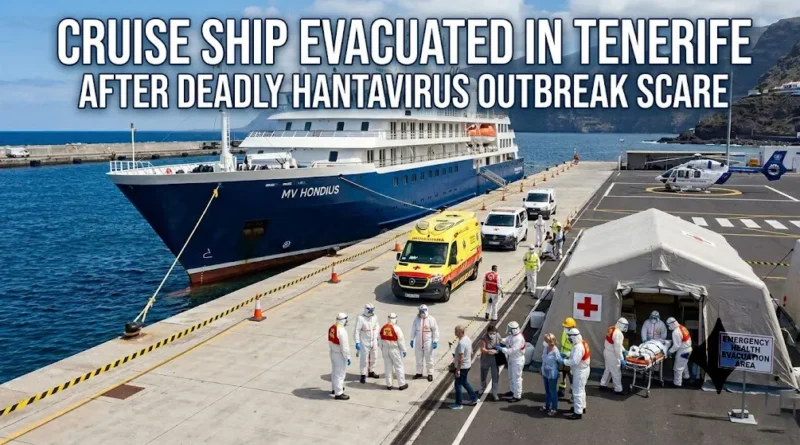
Cruise Ship Evacuated in Tenerife After Deadly Hantavirus Outbreak Scare
The MV Hondius, operated by Oceanwide Expeditions, arrived at the port of Granadilla de Abona carrying 147 people three already dead from the Andes virus triggering one of the most complex international health evacuations in recent memory.
3 Deaths Confirmed | 8 Suspected Cases | 147 On Board at Tenerife | 19 Nationalities Evacuated |
On April 1, 2026, nobody on board the Dutch-flagged cruise ship MV Hondius could have foreseen the ordeal that was to come in the South Atlantic when it made its way to sea. On April 1st, 2026, the MV Hondius, a Dutch cruise ship, quietly departed from Ushuaia, Argentina, with no one on board expecting the drama to unfold in the South Atlantic. A few days later, passengers began to suffer from extreme illness. By the time it arrived at the Canary Islands on May 10 and docked at Spain’s port of Santa Lucía de Barrameda, three people were dead, several countries were making efforts to bring back their citizens, and the director-general of the World Health Organization (WHO) had flown to Tenerife to personally oversee the operation. The story of the hantavirus outbreak on the MV Hondius, what it means, why it is important, and what it teaches us about the Andes virus, disease outbreaks on cruise ships, and global health preparedness in 2026.
What Happened Aboard the MV Hondius?
Oceanwide Expeditions is a Dutch expedition cruise company that operates the MV Hondius on remote journeys to the polar regions and the subantarctic. It had been an adventure of a lifetime, and a voyage across the Atlantic from the South American tip to Europe, on which the ship had transported passengers from over a dozen countries. It was, however, to be the epicenter of the first hantavirus outbreak on a cruise ship in history.
Key Dates: A Timeline of the Outbreak
April 1, 2026, MV Hondius departs Ushuaia, Argentina, with passengers aboard.
April 11, 2026, a Dutch passenger, identified as the index case, dies from hantavirus on board. OnOn
April 24, 2026, the body is removed from Saint Helena. The index case’s wife disembarks but dies two days later in a Johannesburg hospital.
May 2, 2026, A cluster of passengers with severe respiratory illness is formally reported to the WHO. A third passenger dies on board.
May 6, 2026, The ship departs Cape Verde for Tenerife after Spain approves its arrival. Eight total suspected cases confirmed worldwide.
May 10, 2026, MV Hondius docks at Granadilla de Abona port in Tenerife. Multi-national evacuation operation begins under WHO supervision.
The first case on board the ship, known as the “index case,” was a Dutch citizen who had been travelling on a road trip in Chile, Uruguay, and Argentina for four months before the trip. He was probably exposed to infected rodents during the activity of birdwatching in nature, Argentine health authorities believe.
How Did Passengers Get Hantavirus on a Cruise Ship?
The question on everyone’s mind, and it’s a good one. Most people think of hantavirus in rural areas, old barns, hiking trails, rodent infested cabins. A cruise ship is the place you wouldn’t expect to feel like you’re on a cruise ship. How did this occur?
The Index Case and Initial Exposure
In short, it’s probably before the passengers ever boarded the MV Hondius. The index case contracted the infection from excretions from rodents (urine, droppings, or saliva) during his months of travel in rural South America. The Andes strain of hantavirus is spread by the long-tailed rice rat (Oligoryzomys longicaudatus) and is a rodent-borne virus. But the Andes virus did something unusual after he got on board, spreading between people.
Why the Andes Virus Is Different
There are over 50 types of hantaviruses, but only one is known to transmit between people: the Andes virus. All other strains need to be in contact with infected rodents or their feces. The exception to this is the Andes strain, which is mainly found in South America. It is also responsible for Argentina’s historically high fatality rate of ~32%.
KEY ANDES VIRUS FACTS
- Only the hantavirus strain known to transmit between humans
- Causes a serious lung disease, known as hantavirus pulmonary syndrome (HPS)
- The fatality rate is about 32% in Argentina (higher than in other strains).
- The overall HPS fatality rate in the Americas ranges up to 50% in some studies.
- No licensed antiviral treatment or vaccine is available.
- Person-to-person spread requires close, prolonged contact or exposure to bodily fluids.
“This is not another COVID.”
Tedros Adhanom Ghebreyesus, WHO Director-General, May 10, 2026
The Word You Cannot Say on a Cruise Ship
Veteran cruisers will tell you that there is one word that sets the hairs on the backs of the ship’s crew into a frenzy outbreak. The cruise lines go to great lengths to avoid using that word; they like to use “elevated illness reports” or “gastrointestinal incidents. Why? An outbreak declaration is required to be reported to the CDC; it’s a federal thing, and it also gets a lot of press attention that can kill bookings for years. The irony in the MV Hondius hantavirus story is that the ship’s owners, Oceanwide Expeditions, did not have an operations manual for this. Norovirus? They deal with that. A respiratory virus that kills 30-40% of people infected, spreads from person to person. This is a whole new ball game. First-hand accounts of the ship’s medical unit describe it as small and routine, with anti-inflammatory drugs, basic over-the-counter medication, and oxygen tanks. It was not designed to deal with a biocontainment situation.
How Long Does It Take to Get Sick From Hantavirus?
The incubation period of hantavirus is, in part, the most disturbing part of the disease, and a main reason for the worldwide contact-tracing campaign, which can be prolonged and erratic.
The Incubation Window
The incubation period of hantavirus is, in part, the most disturbing part of the disease, and a main reason for the worldwide contact-tracing campaign, which can be prolonged and erratic. The Incubation Window The CDC reports that the signs and symptoms of HPS following exposure to the Andes virus may occur anywhere from 4 to 42 days later, with a median of about 18 days. Similarly, the WHO states that the symptoms usually start 1-8 weeks after exposure. This is due to the large number of passengers and contacts from the MV Hondius being monitored by health authorities for four to five weeks. The big window of opportunity is the reason that the hantavirus contact tracing is so complicated and so essential. Before even diagnosing the outbreak, 30 passengers had disembarked the MV Hondius at Saint Helena. One of the passengers who got caught returned home to the remote South Atlantic island of Tristan da Cunha, where they developed symptoms, and the British Army’s medics parachuted onto the island (without an airport) to be of service.
Early Symptoms to Watch For
There are two stages of hantavirus disease. The early symptoms are often confused with the flu: fever, fatigue, muscle pain, headache, dizziness, chills, feeling sick to your stomach, vomiting, diarrhea, and abdominal pain. In HPS cases, the disease progresses quickly within 4-10 days with symptoms of severe difficulty in breathing, lung congestion, and a sudden decrease in blood pressure.
HANTAVIRUS SYMPTOMS KNOW THE SIGNS
- Fever, chills, and severe fatigue (early stage)
- Muscle aches, especially in the thighs, hips, back, and shoulders
- Nausea, vomiting, diarrhea, abdominal pain
- Dry cough progressing to breathing difficulty (late stage)
- Lungs filling with fluid, hantavirus pulmonary syndrome
- Rapid drop in blood pressure in severe cases
- Symptoms appear 4–42 days after exposure (median ~18 days)
The Tenerife Evacuation: An ‘Unprecedented’ Operation
At about 5:30 a.m. on 10th May, the MV Hondius finally docked in the port of Granadilla de Abona on the island of Tenerife, accompanied by a great deal of political and public tension. Since then, Fernando Clavijo, president of the Canary Islands, has been claiming for days that the ship cannot dock, due to the fears of residents who still feel the effects of the COVID-19 pandemic. The national government of Spain overrode him based on international law and humanitarian considerations.
How the Evacuation Worked
Small boats were used to take passengers from the anchored ship to shore. All staff members were fully protected in hazmat suits, face masks, and respirators. Passengers were reportedly disinfected through the use of a spray before getting on board evacuation aircraft in videos from the port. On the first day, 94 passengers of 19 different nationalities were evacuated. The Spanish nationals took to the air first, to the Torrejón de Ardoz military airport near Madrid. A Canadian plane left soon after, and another from the Netherlands, Germany, Belgium, and Greece, chartered by the Dutch, was leaving.
Americans Bound for Nebraska Medicine
All 17 Americans who were passengers were put on repatriation planes Sunday evening, the US Department of Health and Human Services said. The two were put into the biocontainment units of the plane, which showed mild symptoms, and the other, who had tested mildly positive for the Andes virus through a PCR test. All US evacuees were moved to Nebraska Medicine, one of the most specialized high containment treatment centers in the United States.
Another French evacuation flight was also special: French Prime Minister Sébastien Lecornu said that one of five French nationals brought back from Tenerife was beginning to show symptoms during the flight, leading to the immediate strict isolation of all five upon landing.
Global Response: WHO, Tedros, and ‘Not Another COVID’
All 17 Americans who were passengers were put on repatriation planes Sunday evening, the US Department of Health and Human Services said. The two were put into the biocontainment units of the plane, which showed mild symptoms, and the other, who had tested mildly positive for the Andes virus through a PCR test. All U.S. evacuees were shifted to Nebraska Medicine, the most specialized high containment treatment center in the United States. Another French evacuation flight was also special: French Prime Minister Sébastien Lecornu stated one of five French nationals returned from Tenerife had started to show signs on the plane, so the five were immediately placed under strict isolation on arrival.
Is Hantavirus Contagious Between People? What This Outbreak Tells Us
No, for most of the 50 or so known strains. Yes, but there are important caveats.
It has been shown that the Andes Virus can be transmitted from person to person, but this is rare and requires close, sustained contact. This would occur between family members or intimate partners – not just casual acquaintances.
Major health media outlets interviewed by experts have all agreed that the current outbreak is not similar to COVID-19’s early dynamics. The virus does not spread by brief airborne contact. The virus doesn’t spread at a large scale asymptomatically. The global response was fast, transparent, and coordinated.
“Personally, I’m not worried. There’s been a very swift and prompt response. Hopefully, the public feels reassured that there’s a plan in place.”
US infectious disease expert, TODAY, May 2026
Hantavirus Treatment: What Options Exist?
Here is the sobering reality: there is currently no licensed antiviral treatment or vaccine for hantavirus infection, including the Andes strain. The CDC, WHO, and all major health authorities confirm this.
What does exist is aggressive supportive care, and it makes a real difference. Getting patients into intensive care quickly, managing fluid in the lungs, supporting blood pressure, and providing supplemental oxygen can significantly improve survival outcomes. The fatality rate for HPS in the Americas can reach 30–50% without prompt expert care. With early hospital intervention, that number can be meaningfully reduced.
This is why the evacuation to specialized facilities like Nebraska Medicine’s RESPTC matters so much. These are purpose-built isolation units with staff trained in high-risk pathogen protocols and equipment to manage the rapid respiratory deterioration that hantavirus can cause.
Frequently Asked Questions
How did people get hantavirus on the MV Hondius cruise ship?
The outbreak most likely originated from a single passenger, the index case, who was exposed to infected rodents during a four-month road trip through Chile, Uruguay, and Argentina before boarding the ship. Once on board, the Andes strain spread to other passengers through close contact. The Andes virus is the only known hantavirus strain capable of person-to-person transmission.
What is the one word you cannot say on a cruise ship?
“Outbreak” is the word cruise ship operators, staff, and crew notoriously avoid. It triggers federal reporting obligations, strict CDC protocols, and significant negative media coverage. The MV Hondius situation made that avoidance impossible. This was a textbook outbreak by any definition, and the first involving hantavirus on a cruise ship.
How long does it take to get sick from hantavirus?
The incubation period for hantavirus, specifically the Andes strain, ranges from 4 to 42 days, with a median of approximately 18 days. Symptoms often begin to appear 2 to 4 weeks after exposure. This wide window is why health authorities are monitoring all MV Hondius passengers and contacts for 42–45 days.
What cruise line has the hantavirus outbreak?
The outbreak occurred aboard the MV Hondius, a Dutch-flagged vessel operated by Oceanwide Expeditions, a Dutch expedition cruise company. The ship departed Ushuaia, Argentina, on April 1, 2026, and docked at the port of Granadilla de Abona in Tenerife, Spain, on May 10, 2026, for a coordinated international evacuation.
Is hantavirus contagious between people?
For most of the more than 50 known hantavirus strains, no human-to-human transmission is known to occur. The Andes virus, the strain involved in the MV Hondius outbreak, is the one known exception. Even for Andes, person-to-person spread requires close, prolonged contact and appears most likely during the early phase of illness.
What is the hantavirus fatality rate?
The fatality rate for hantavirus pulmonary syndrome (HPS) caused by the Andes strain in Argentina is approximately 32%, and can reach up to 50% in some studies of the Americas. There is no approved antiviral treatment or vaccine, making early diagnosis and intensive supportive care critical for survival.
Could the hantavirus outbreak lead to a pandemic?
Experts and the WHO strongly say no. Unlike COVID-19, the Andes virus does not spread through casual airborne contact, does not transmit asymptomatically at scale, and has not shown the exponential spread patterns associated with pandemic pathogens. The WHO’s risk assessment for the general public remains low.