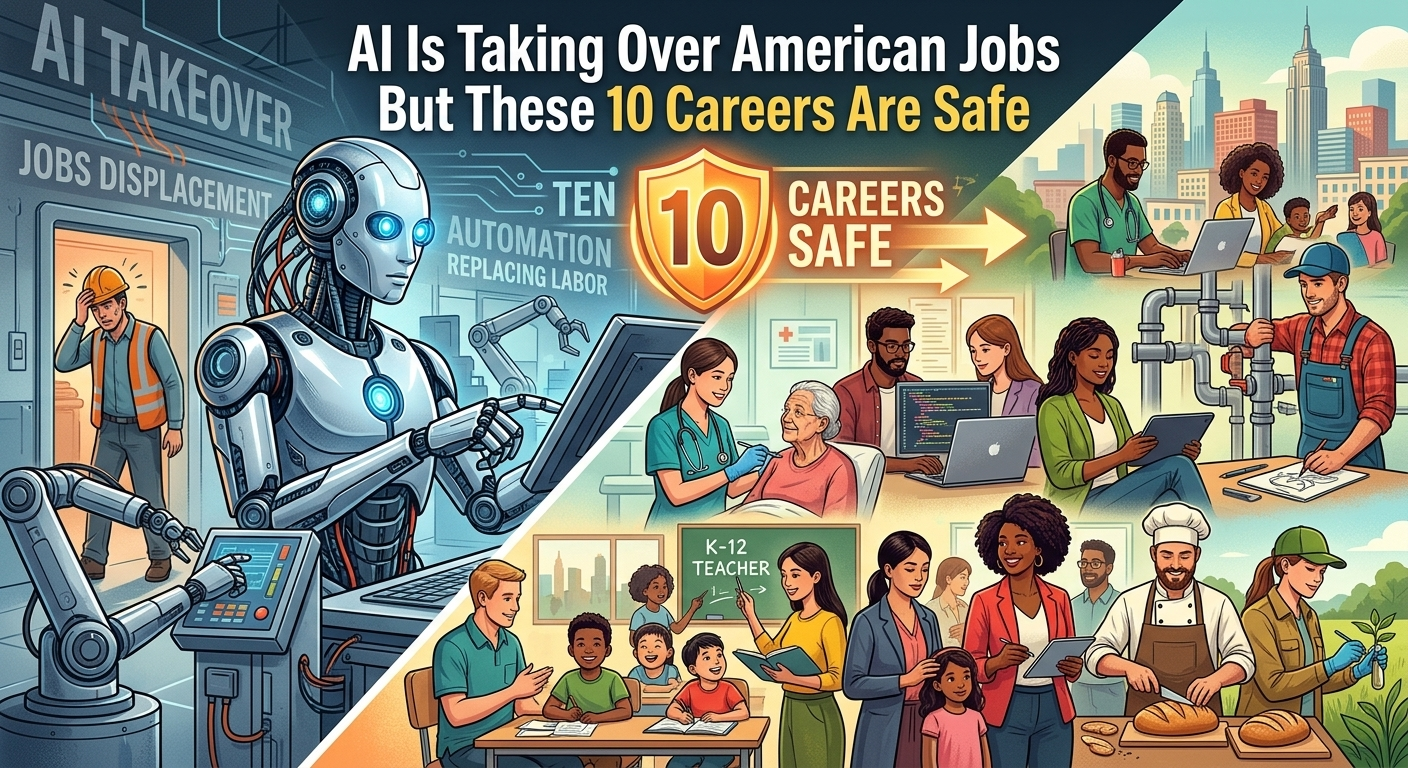
AI Is Taking Over American Jobs But These 10 Careers Are Safe
It’s not like we’re not being realistic here; the fear is warranted. There is a new headline about the replacement of lawyers, writers, coders, or customer service teams by AI at least once a week. This time, it’s not only hype. AI automation is already having an impact on jobs in America, and hundreds of thousands of white-collar positions are being restructured, cut, or eliminated since 2023.
However, the majority of those fear-inducing headlines are missing this important factor: Not all jobs are at the same risk. In fact, according to a growing number of studies from MIT, McKinsey, and the World Economic Forum, there’s a very important truth that large language models and robotic systems can’t competently duplicate anytime soon: jobs that are safe from AI share a set of deeply human characteristics.
Before you get into a downward spiral, breathe. This guide is available to provide clarity. Taking the time to sift through the numbers, review these workforce trend reports, and gauge the value of the 10 jobs that are truly AI-proof in 2026, and understand why automation just can’t do them.
Why Is AI Taking Over Jobs So Fast?
In order to recognize which jobs are not replaceable by AI, it is helpful to first understand the many reasons why AI is so successful at replacing other jobs. In essence, AI is better at three things: recognizing patterns, processing massive amounts of data, and producing plausible outcomes from training data. Provide it with a repetitive task, structured data, or a set of rules, and AI shall outperform most humans time and time again.
That is why Data Entry, Simple Legal Research, Financial Reports Generation, Some Coding, and Customer Service Scripting jobs are becoming automated at an alarming rate. They are not bad jobs, they are simply structurally weak to what AI does well.
However, when a task demands genuine empathy, true physical dexterity, ethical judgment, creative intuition, and the trust that can only be established through a human relationship, AI begins to fall apart. Well, that’s where our list starts.
The 10 Best Careers in the Age of AI (That Automation Won’t Touch)
Career #01 Registered Nurse & Frontline Healthcare Professional
This is at the pinnacle of the categories of health care jobs that will not be replaced by AI. Nursing is a matter of split-second physical judgment, a real hands-on experience of patient care, comfort in the emotional moments of terror, and an intuitive clinical judgment acquired over years of life. If the patient is crashing, he doesn’t need an algorithm. They require a trained human being at their bedside, making quick decisions. AI is a valuable diagnostic tool in hospitals, but not yet a tool for giving IV. While AI is great to help diagnose in hospitals, it won’t be helping with holding hands along the way to a cancer diagnosis any time soon.
Why Safe: Physical care + emotional intelligence + crisis judgment is the unique reason that makes it safe.
Career #02 Licensed Mental Health Therapist / Psychologist
Is it possible for AI to substitute for therapists? No, and here is one of the most obvious answers on this list. The therapeutic alliance is the foundation of therapy, a very intimate relationship, a trust and openness, and a real attunement of the human being. While offering a level of psychoeducation and mood tracking, chatbots such as Woebot have found a place in mental health support. The careful, nonverbal, heartfelt work with complex trauma, personality disorders, and suicidal ideation of a licensed therapist is a human mind and a human heart. Where AI’s limitations are most prominent is in this job that demands emotional intelligence.
Why Safe: Therapeutic trust + complex emotional attunement
Career #03 Skilled Trades: Electrician, Plumber & HVAC Technician
If you ask any economist about the outlook of skilled trades, you will hear one thing: it’s an incredibly bright future. These positions involve working in uncertain real-world settings, such as crawling through walls, diagnosing problems while on the job, and coming up with solutions as they arise in unusual places. There are no robotic systems that can be as adaptable as a skilled electrician when working in a 100-year old building, and for a long time, there won’t be. In the meantime, America is overwhelmed with a shortage of tradespeople due to the baby boomers’ retirement, so this is one of the most future-proof trades to make in 2026.
Why Safe: Physical dexterity + real-world improvisation + massive shortage
Career #04 K–12 Teacher & Special Education Specialist
Education is one of the sectors in which people are sure to see AI disruption, and then they look more closely and realize they are wrong. Yes, AI tutors such as Khan Academy’s Khanmigo are amazing. However, they are supplements, not substitutes. At its core, teaching is about the development of humans: knowing the mood of a classroom, knowing which child isn’t doing well at home, knowing which child thinks he is stupid and can’t do it. Among the most critical and different requirements of special ed are the need for individual human responsiveness that no algorithm can provide. Is it possible to have AI do the job of teacher & therapist? No way, no how, no way at all!
Why Safe: Human development + social-emotional mentorship
Career #05 Creative Director & Brand Strategist
But now it gets tricky and significant. AI can create images, copy, and produce decent marketing materials at scale. However, it can only lead to a breakthrough creative vision. It can’t read a brand’s history and see the cultural moment, feel the emotional pulse of an audience, and combine it all into a campaign that is a cultural touchstone. That is the job of a human Creative Director. The most creative jobs that won’t get replaced by AI are those that demand cultural savvy, aesthetic bravery, and a willingness to venture into new and uncharted thought territories.
Why Safe: Cultural intuition + original creative risk-taking
Career #06 Surgeon & Interventional Specialist
Yes, surgical robots, such as the da Vinci system, are transforming the operating room. However, and this is the key, these are tools used by surgeons, not self-employed surgeons. The surgeon is still making the important decisions: real-time feedback with the tissue; changing plans if anatomy does not match the scan; dealing with unexpected hemorrhage, etc. Surgery requires a level of physical skill, on-the-spot decision making, and legal and ethical responsibility that will continue to keep humans playing a central role in this profession for the foreseeable future.
Why Safe: Real-time adaptive judgment + legal accountability
Career #07 Social Worker & Community Advocate
Social work is one of the occupations that won’t be automated in any significant way and is caught between bureaucracy, trauma, and human dignity. When a social worker meets a family in crisis, he or she isn’t simply collecting facts and figures; he or she is interpreting body language, trying to win the trust of a traumatized child, maneuvering through complicated family dynamics, and making protective decisions that have a tremendous impact. This is a job that demands being present, having empathy, making ethical decisions, and a level of cultural competency that is gained through living within a community. The AI can identify risk factors within a database. It is unqualified to perform this task.
Why Safe: Protective judgment + physical presence + community trust
Career #08 Trial Lawyer & Courtroom Advocate
Make no mistake, AI is definitely transforming the legal landscape. A lot of the things that are being done in the document, contract writing, legal research, all of that is being automated very quickly. However, convincing twelve human jurors? That’s another story. In courtroom advocacy, it’s about reading a room live, establishing credibility, using emotional narrative, reacting to unexpected witnesses, and making quick decisions in order to make the presentation effective. The jury and judge are human beings who react to human beings. AI-proof careers 2026 don’t get much more durable than the skilled trial attorney.
Why Safe: Human persuasion + courtroom dynamics + strategic judgment
Career #09 AI Trainer, Prompt Engineer & Machine Learning Ethicist
This one reads like a poem: one of the best jobs in the era of AI is to work with AI itself! The task of training these models, testing their responses in a red teaming fashion, creating the best prompts, and making sure that these models act ethically has to be tackled by someone. The significance of AI ethics and governance is already vital in companies such as Anthropic, Google DeepMind, and Microsoft. It is an area of work where the human element, ethical considerations, and expertise in the technical aspects are closely intertwined, and in fact, where automation is self-evidently impossible.
Why Safe: Meta-level; Humans had to help AI systems.
Career #10 Crisis Responder, Firefighter & Emergency Medical Technician
Whether you’re in a burning building, a flooded neighborhood, or the aftermath of a multi-car wreck, a completely unpredictable situation demands human judgment, adaptability, and split-second decision-making. These are some of the jobs that will remain unaffected by AI, as they fall at the edges of chaos: where AI systems fail most catastrophically. EMTs and firefighters also offer a quality that isn’t quite possible with an algorithm: the soothing and commanding presence of a human being in the midst of the worst moments of a person’s life.
Why Safe: Unpredictable physical environments + crisis human presence
What Skills Should You Build to Survive the AI Era?
If your job isn’t on this list, then the things that make you human and can’t be done by AI are things that you need to cultivate on purpose. What career researchers are consistently finding to be the most lasting skills till the 2030s?
Empathy and emotional intelligence, or understanding, controlling, and reacting to human emotions, rank first on every list. Running side by side with it is the thinking that is as complex as ethical reasoning, which involves balancing and assessing all the values in situations of uncertainty. Another fundamental human strength is the ability to take dots from one domain and bring them together to create novel ideas through creative synthesis. Finally, interpersonal trust building: making other humans feel genuinely seen, heard, and confident in you.
So, if you’re wondering “how can I protect my career from AI?” you shouldn’t try to out-compete AI in its areas of strength! It’s to do more of what it is unable to do.
Is Your Job at Risk? How to Honestly Assess Your Situation
Firstly, think of a mental model: how much of your work today is based on known rules, for regular data? The higher that percentage is, the more at risk your job is from being automated by AI. If you’re mostly dealing with edge cases, human judgment, physical presence, emotional relationships, or creative originality, you’re in much safer territory.
There are some tools available, such as the Oxford Martin School’s Automation Risk Calculator, that can provide you with a crude risk score for your job. However, do not become alarmed at the numbers! Even the highest-risk positions usually have tasks that can be leaned on and leveraged by smart professionals that are still AI-resistant.
What Jobs Will Still Exist in 2030?
The simple answer is… most jobs. The makeup of those jobs will change, though. It is an inevitability that most mundane work will be automated in most jobs, and that humans will have to take on more of a judgmental, oversight, creative, and relationship-building role. The doctor of 2030 will spend less time on notes and more time with patients. The attorney will save time on discovery and more time on strategy. The teacher will reduce his/her teaching time and increase mentorship time.
Of course, not all future-proof jobs are in different professions; many are the same professions, just repackaged as jobs that can’t be outsourced or automated.
Frequently Asked Questions
Q1. What about roles that are not affected by AI?
A1. Those jobs that require physical involvement in an unknown and unpredictable situation, or emotional intelligence, complex ethical decisions, or genuine human interaction are the jobs that best fit the bill. These include nurses, therapists, skilled tradespeople, social workers, surgeons, teachers, trial lawyers, and emergency responders. They all share one thing in common: They require skills (empathy, creativity, adaptability, trust, and more) that AI cannot yet replicate.
Q2. So will a robot take over all the jobs?
A2. No. The reality is that AI is going to change the vast majority of jobs, not replace them en masse. Tasks within roles that can be performed in a routine and according to rules will be automated, but the relational and creative aspects of a role and the human judgment will remain and will often be more valued. AI will generate almost 97 million new jobs by 2030, according to the World Economic Forum.
Q3. What jobs are not suitable for automation?
A3. Jobs that involve manual skill in unstructured settings, incomparable human interactions, and critical decision-making in real-time are the most challenging to automate. Examples of these skills are plumbing, electrician, the front line of healthcare, mental health therapy, social work, and emergency work. These professionals can’t be replaced by the current or near-future AI system.
Q4. Do I have to worry about losing my job to AI?
A4. The way to determine your risk is to look at how much of your daily work is structured by rules for structured data (the most automated work). If you’re focused on client relationships, physical problem-solving, creative judgment, or ethical decision-making, you’re in much safer shoes. You can use tools such as those at the Oxford Martin School to obtain a specific probability estimate for your occupation.
Q5. Which skills need to be acquired to survive AI?
A5. Emphasize skills that AI cannot replace: emotional intelligence, creative synthesis, complex ethical considerations, interpersonal communication, and the capacity to establish real trust. As much as this is true, it’s vital to become accustomed to the way AI should be utilized as a partner, as individuals with the skill to guide, comprehend, and validate AI-generated content will be in high demand in the coming years.
Q6. Can AI replace teachers and therapists?
A6. Not really in any way. While AI tutoring tools can augment learning, and mental health apps can offer helpful psychoeducation, the essence of both fields is the human connection that cannot be replaced by technology. Reading a child’s emotional state and nurturing them in their development is the teaching process. The therapeutic alliance, a relationship of trust and vulnerability, is essential for therapy and can only be formed between humans. AI in both fields is not a replacement; it is a tool.
Q7. What is a career that AI cannot replace?
A7. An AI-proof career is a job that is fundamentally based on human skills, such as physical presence, emotional attunement, creative originality, ethical judgment, or trust that cannot be shown to AI. The 10 careers listed in this article are the best examples of careers that are not likely to be affected by AI in 2026 or further.