Why AI Transformation Is a Governance Crisis Not Tech
Let’s bust the biggest AI myth right now: Your transformation isn’t stalling due to poor models.
The reason it’s stalling is that nobody owns the consequences of these models going wrong.
It’s not just a problem of technology. It’s not a technology problem.
AI transformation is an issue of governance. Stop. The data are clear, the pattern is constant, and the costs of ignoring them increase every quarter. This article will explain how this is true, what governance looks like in the year 2026, and what happens to companies that ignore governance.
The Numbers Don’t Lie: AI Is Failing at Scale
This is what the landscape looks like right now. It should make you shiver.
In 2026, global enterprise AI spending will reach $665 billion. Approximately 73% of these deployments won’t deliver the ROI projected. This is not an error; it’s the most common outcome of enterprise AI.
S&P Global’s survey of more than 1,000 companies in 2025 found that the number of firms abandoning AI initiatives increased from 17% to 42%. The failure rate has more than doubled in a year. MIT’s GenAI Divide Report tracked $30-40 billion of enterprise generative AI spending and found that only 5% of generative AI projects produced measurable P&L impacts.
Deloitte’s 2026 State of AI in the Enterprise Report, based on 3,235 senior executives, revealed that only 1% of businesses consider themselves AI-mature. Only 34% of them have genuinely reimagined their business around the technology.
These aren’t just random statistics from skeptics. The consensus findings of the most rigorous research conducted by enterprises all point to one thing: AI transformation is not a technology problem, but a governance problem.
The models work. They are working, but the organizations around them aren’t.
What Does “Governance” Actually Mean Here?
Before we move on, let’s clarify what governance really is in this case since this term is applied loosely, and this lack of definition is a major issue.
AI governance isn’t an official document that is placed within the compliance folder. It’s not an annual committee meeting to examine the risk register. It’s not a checklist you must check before submitting an AI idea to the board for approval.
Real governance is the system that can answer four key questions, on a large scale, in real-time, and across every AI system that your company operates:
- Who is the authorized person for this model?
- Who is responsible for the risk in case it does not succeed?
- Who approves the changes?
- Who is responsible when a product causes harm?
If the questions you ask don’t have clear, well-documented, and answer that is enforceable answers for each AI system that is in operation, there is no governance. It’s just a matter of appearance governance. But the appearance is destroyed when something goes wrong, which is the case with AI systems that operate in pricing, hiring, credit, and customer service, which is a matter of time, not when.
A strong governance system defines accountability before deployment. Poor governance can reveal accountability gaps in an incident. A poor governance system has no accountability in the first place, simply a chain of people looking at one another while the regulator is writing the fine.
The Accountability Vacuum at the Top
The governance issue is rooted in structural issues and is rooted within the Boardroom.
McKinsey’s study finds that just 28% CEOs have direct charge of AI governance. A mere 17% board directors officially control it. The NACD 2025 survey of board members discovered that the majority of boards have regular AI discussions, but only 27% have put in place AI governance in the charters of their committees.
Translate that into a practical, real-world. AI systems are influencing the decisions to price as well as credit approvals and even the outcome of hiring decisions within companies, where around four-in-five enterprises don’t have clear chains of executives accountable for what these AI systems are doing.
Deloitte’s survey of 2025, which surveyed 700 directors and executives of boards across 56 nations, found that 66% of the boards reported only limited or no AI knowledge. A mere 14% have discussions about AI during every meeting, even though AI-driven processes run in their businesses continuously.
It is the result of a flaw in clearly defined accountability for leadership. If boards are not accountable, accountability is diluted. If accountability is unclear, no one is accountable for the actions AI performs after deployment. When nobody is able to answer the risks, they build up until they are exposed as an emergency that shocks all, not just the ones who were supposed to oversee the AI.
AI risk is a leadership risk. Governance gaps at executive levels aren’t just a small oversight. It’s a governance issue. Everything downstream, including data integrity issues, model drift, exposure to regulatory requirements, and unsuccessful ROI, comes because executive accountability was never established in the first place.
Why 70% of AI Projects Never Leave the Pilot Phase
This is a pattern that occurs in every enterprise, and it nearly always has the same look.
A business unit discovers an extremely valuable AI application. The idea is approved based on a compelling business argument. The team constructs a functioning prototype. The prototype works well in controlled conditions. Then, it goes to there’s nothing. The project is stalled near the point of no return between production and pilot, at which point the questions of organization become more complicated than technical ones.
Who approves deployment into live systems? What type of monitoring is needed? Who is responsible for monitoring the model’s performance? What is the appropriate escalation route when the model creates negative output? What is the relationship with the privacy requirements for data? Who is responsible for reviewing it when regulations are changed?
These aren’t tech-related questions. They’re governance-related questions. In the majority of companies, there aren’t any answers to them, not because anyone knows enough about them to solve these questions, but rather because there’s no governance structure in place that can force answers before the project gets to them.
McKinsey’s worldwide AI research is clear in this regard: businesses that are actually benefiting from AI aren’t just deploying new tools. They are changing operational models, workflow management practices, databases, and adoption strategies in the context of AI.
The data from Deloitte shows that even though companies have widened access for workers to AI, only 25% of them have put 40 percent to 50% of their AI experiments into production, with 54% predicting to hit that mark within a period of six months, a gap that persists for several years, but has not closed.
This is a governance gap. The giving of employees AI tools isn’t a comprehensive transformation. Redesigning the company around AI and incorporating accountability frameworks, structures, and the decision-making authority to make the change stick and last is a transformation. The difference lies in governance.
The Regulatory Reality: Governance Is No Longer Optional
If the case for a strong governance system wasn’t compelling enough by itself, the regulatory landscape in 2026 has rendered the discussion irrelevant. Governance is no longer a choice that is strategic. In many organizations, it’s an obligation of law with serious financial penalties for failure to comply.
The EU AI Act Is in Full Enforcement
The EU AI Act, Regulation (EU) 2024/1689, came into force in August 2024 and is the world’s first comprehensive legal framework for artificial intelligence. In the case of high-risk AI systems, the August 2026 deadline for enforcement is not an opportunity to issue a warning. It’s active enforcement.
Fines for non-compliance are up to 35 million euros (or 7%) of the global annual turnover, whichever is greater. The Act is applicable extraterritorially, which means any company that serves customers in the EU market is covered, regardless of where it’s headquartered. A US company that has European customers who use artificial intelligence-controlled credit score, recruitment, and customer support systems is operating within the EU AI Act obligations.
The Act demands highly risky AI systems to implement regular risk management processes integrated in every stage of deployment, ongoing monitoring of the production process, and audit trails that can be changed, which link each model’s output back to the source information, its model’s versions, and the governing policies. This is governance infrastructure, not compliance theater, and operational governance incorporated in every stage of the AI lifecycle.
The US Regulatory Surface Area Is Multiplying
In the United States, there is no federally specific AI law, which hasn’t stopped the enforcement. More than 1,100 AI-related laws were introduced by 2025. States comprising Colorado, California, and Texas have passed AI disclosure in order to prevent bias and risk management regulations. In the absence of a uniform federal framework, compliance requirements haven’t diminished; rather, it has increased the coverage of compliance across different states.
Boards are now faced with the responsibility of being fiduciary for AI failings. In the absence of governance, it is not only a risk to reputation but also a personally-related legal risk for executives as well as directors. The traditional approach of treating AI governance as an issue of concern for the future is no more. It’s here. Organisations that have prepared comply. Organisations that didn’t prepare are exposed.
What Governance Failures Actually Look Like in Practice
The effects of insufficient AI governance are not a theoretical concept. Actual incidents in 2024 and 2025 show two types of costs: business risk and ethics risk.
Governance failures are often manifested on the business side as a failed ROI, operational disruption, and regulatory penalties. Model drift is a problem that occurs when a model is not monitored for performance. As real-world data changes, the model will degrade over time. A system that performs well in testing may produce substandard or even harmful outputs months later without anyone noticing.
In terms of ethics, AI systems that are used in the hiring, credit, and law enforcement processes without adequate human oversight have led to discriminatory results, which expose organizations to lawsuits, regulatory actions, and reputational damages. These incidents were not caused by poor models. The AI Incident Database consistently shows that these incidents are almost always the result of a failure in oversight, compliance, and accountability.
A study by MIT Sloan in 2025 found that 61% enterprise AI projects are approved based on projected value, which is never formally assessed after deployment. Executives approved AI projects based on compelling cases and then moved on. Nobody was given ongoing leadership responsibility to ensure that the system delivered on its promises.
This is not a failure of technology. This is a governance fail of the most fundamental kind: failure to close the loop between investment and result.
What Strong AI Governance Actually Looks Like in 2026
Enough diagnosis. What is the actual solution?
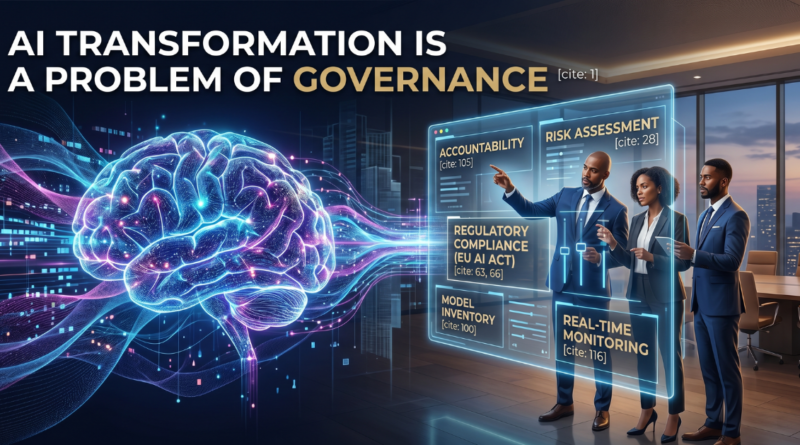
In 2026, operational infrastructure will cover the entire AI lifecycle. It’s not a paper; it’s a system. What mature enterprise AI governance needs:
1. AI Inventory That You Can Trust
Harvard Business Review’s research indicates that the majority of enterprises are using 2-3 times more AI than they realize. You must first know what you are governing before you can manage AI. This means creating a comprehensive, real-time inventory of all models, agents, and AI-assisted processes in production, including documentation on their capabilities, data sources, and decision scope.
This is the first step that many organizations miss. Visibility is essential for governance.
2. Accountability structures at every level
The chain of ownership must continue from the board all the way to the model. The charter of the board-level AI governance committees must include a formal assignment of AI oversight responsibilities. Accountability at the executive level must be explicitly stated, and not implied. Owners of business units need to be able to clearly identify every AI system in their domain and have defined escalation pathways when things go wrong.
It is only when there is a clear understanding of who’s responsible that an incident can be contained.
3. Approval gates for Lifecycle Control
Each AI system should have a governance checkpoint for each phase of its lifecycle, including design, development and testing, deployment and monitoring, retirement, and retirement. Before a model can move from one stage to the next, approval gates should require documentation of risk assessments, bias analyses, and compliance checks.
It is this that separates the organizations that move 25 percent of their AI experiments to production from those that move only 5 percent. It is not the capability, but the structured oversight that helps answer organizational questions before they turn into deployment blocks.
4. Real-time Monitoring and Model Integrity
AI systems, which retrain and adapt over time, are not suitable for static audits or periodic reviews. Effective governance requires constant monitoring of model behavior, including tracking performance metrics, biased indicators, and output distributions compared to baselines.
Dashboards that are ready for governance can show a model’s drift in real-time. Automated alerts are sent when a model generates anomalous results. Strong oversight frameworks view model integrity as a continuous operational responsibility and not just a deployment checkbox.
5. Audit Readiness Standard Operating Procedure
The ability to retrieve logs, approvals, and traceability records on demand is essential. The EU AI Act demands an immutable audit trail that ties every output back to its source, version of the model, and governing policies. The “Measures” function of NIST AI RMF requires sufficient logs for regulatory review.
In 2026, audit readiness is not something you do every time a regulator contacts you. It is an operating discipline that is embedded in how AI systems are run daily.
6. Cross-Functional Governance Team
A single department cannot be responsible for effective AI governance. This requires a genuine collaboration between legal and compliance, data scientists and engineers, privacy and data security, product and business leaders, and internal auditors. Silos in governance teams produce documents on governance that are not enforced.
In 2026, the best governance model is one in which every function has a stake in the outcome, clearly defined responsibilities, and real authority to voice concerns that lead to actual responses.
The Three Governance Maturity Tiers: Where Does Your Organization Sit?
Not all organizations start from the same point. Practical governance models take into account where an organization is currently.
Tier 1 (Basic Governance): Documentation exists, but it is not applied consistently. The accountability is unclear. Monitoring is done periodically. Crises are triggered by incidents. The majority of enterprise AI operates on this level, regardless of the stated commitment to governance.
Tier 2 Structured Governance (Proactive): A defined accountability structure exists. There are lifecycle controls in place. Continuous monitoring is done for critical systems. Systematically, regulatory compliance is tracked. Governance reviews are conducted on a regular basis, not just after incidents.
Tier 3 Governance maturity (Strategic): AI governance is integrated into the enterprise operating model. Governance frameworks are integrated with business strategy and capital allocation. On demand, external stakeholders, such as regulators, auditors, and customers, can have confidence in the company. Governance is more than just risk management.
Most organizations should be focusing on the transition from Tier 1 to Tier 2. This doesn’t mean perfect governance. Structured governance, accountability, oversight, and documentation are required to avoid the most expensive failures and build a foundation for improvements.
Conclusion
The AI models that will be available in 2026 will be remarkable. The technology has advanced to a point where most organizations haven’t yet fully tapped into its potential.
Technology doesn’t change organizations. Technology is a lever that organizations use to transform themselves. Governance is the key factor that will determine whether this lever works. It includes accountability structures, governance frameworks, standards for data integrity, and the decision-making authority to turn AI capabilities into business value.
Those organizations that internalize it in 2026 will continue to gain AI advantages for the remainder of the decade. Organisations that continue to treat governance as a compliance burden rather than a strategy enabler will see their AI investments disappear. Not because the models did not work, but because they never got the support of the organization.
AI transformation is a governance problem. The governance crisis has arrived, the regulatory clock is ticking, and inaction will cost you dearly.
It’s a question of whether you want to wait until a crisis occurs to have the conversation or start it right away, when there is still time to create something lasting.
FAQs
Q1: What is meant by saying that AI transformation is a governance problem?
A1: Most AI initiatives fail because organizations lack accountability, oversight, data integrity standards, and decision-making authority in relation to their AI systems. Governance infrastructure is either missing or insufficient to move AI from pilot production to large-scale production.
Q2: Why do so many AI enterprise projects fail in 2026
A2: S&P Global reported that in 2025, 42% of companies will abandon the majority of AI initiatives, compared to 17% in 2020. Governance failures are the primary reason: unclear ownership, inadequate monitoring and no defined escalation process. There is also a gap between approval and accountability of AI investments.
Q3: What does the EU AI Act require in terms of enterprise AI governance?
A3: The EU AI Act, the first comprehensive legal framework in the world for AI systems with high-risk compliance requirements, will be active from August 2026. The EU AI Act requires continuous risk management, production monitoring, human oversight mechanisms, and audit trails that cannot be altered. Non-compliance penalties can reach EUR35m or 7% global turnover.
Q4: What is the key to a strong AI Governance Framework?
A4: A comprehensive governance framework should include: a complete AI systems inventory, defined accountability structures on every organizational level; lifecycle approval gates; real-time monitoring of models; cross-functional governance team members; and audit readiness.
Q5: What exactly is model governance, and why does this matter?
A5: Model governance is the set of policies, processes, and accountability structures that manage AI models throughout their full lifecycle, from deployment and development to monitoring, retraining, and retirement. This is important because AI models are prone to drifting over time and produce outputs that shift as the real-world data changes. Organizations have no way to detect and respond to this degradation without model governance.
Q6: What’s the difference between IT Governance and AI Governance?
A6: IT governance is concerned with how technology systems are managed and secured in order to align them with business goals. AI governance expands on that foundation by covering the unique risks associated with AI: model biases, algorithmic authority and automation biases, explainability requirements, and ethical dimensions to automated decision-making. AI governance is based on IT governance but goes much further.
Q7: How can a company improve its AI governance maturity level?
A7: To understand what’s actually being run, start with an inventory of your AI systems. Establish clear accountability, i.e., who is responsible for each system, who approves modifications, and who escalates incidents. Documented approval gates will help you add lifecycle controls. Monitor critical systems continuously. This foundation allows governance maturity to develop systematically, rather than reactively.
Stay Ahead of the AI Governance Conversation with USA Times Square
The governance crisis of enterprise AI will be one of the most important business stories in 2026. USA Times Square provides real-time reporting, expert analysis, and in-depth coverage on AI transformation, business leadership, and regulatory changes reshaping the way organizations operate.
Bookmark USA Times Square for analysis that cuts through noise and keeps you in front of important decisions.
In a world in which AI transformation is a problem of governance, organizations that grasp it the earliest are the ones who will win.