
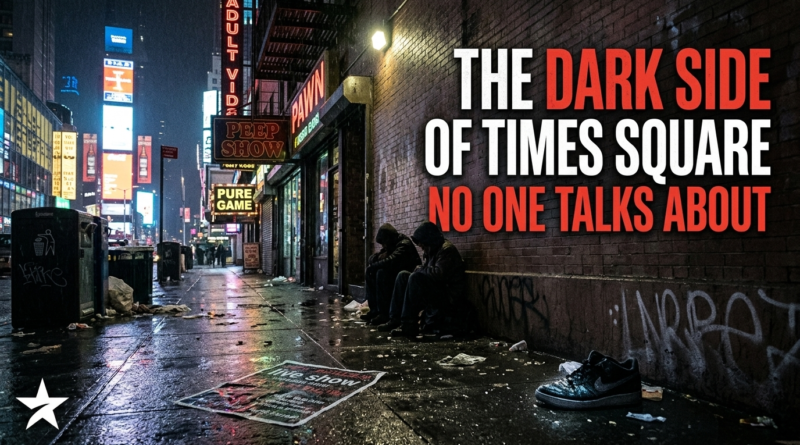
The Dark Side of Times Square No One Talks About
Each year, approximately 131 million people descend upon the streets of Times Square looking for magic: the lit-up billboards, the sound of the city, and the thrill of being at the Crossroads of the world. The show is actually an INA mast presentation. But so is the shadow which dwells next to him. The various cards that run the show in the dark side of Times Square are not featured in tourist brochures, rarely ever seen by travel influencers, and seldom discussed directly by city officials.
Don’t get me wrong, don’t read a fear-mongering attack on NYC. The facts are complicated, and there’s room for a sincere discussion. So, let’s have one. Here, here talks about all that the postcards don’t tell you if you’re a first-time visitor, if you are a New Yorker trying to figure out the news of he last several days, or simply, because you’re curious.
When Was Times Square Bad? A Quick History
To experience modern-day Times Square, you should first experience what it was. The answer is quite terrifying! Then everything turned dark in the 60’s to the early 90’s, and the Streets of 42nd Street were filled with go-go bars, sex shops, peep shows, and adult theaters, all of which came to represent the City’s downfall.
By the mid-1980s, the rate of crime complaints in 40 to 50 had jumped to more than 15,000 annually. In 1984, there were 2,300 crimes committed per year on the block between 7th Avenue and 8th Avenue along 42nd Street, 20% of which were Felonies. In short, it was one of the most perilous neighborhoods in American cities.
The city was the center of everyone’s “deuce,” 42nd Street, which became famous as a major center of pornographic movies and illegal street prostitution. In the mid-1980’s, the problem of drug dealing, especially dealing in crack cocaine, rose to a significant level throughout. Police officers were supposed to have a crowd of three or four on the block just to protect themselves.
It was in the 90s that the city went to work with mayor Rudy Giuliani and governor George Pataki to make over Times Square as a whole. The New Amsterdam Theatre’s transformation into Disney’s went from a problem to a prize for an affectionate neighborhood, serving as a representative model of the rest of the area’s change from street-level grit to corporate polish. The clean-up was a success, spectacular success. The number of crimes in Times Square has dropped 85% since 1990.
However, Times Square was very bad. After that, it was very good. However, the story of 2026 is less clear.
Times Square Crime 2026: What the Numbers Actually Say
85%
Crime has dropped since 1990
2,800+
Sanitation complaints (ZIP 10036) since 2022
50+
NYPD officers specifically assigned to Times Square
200%
Increase in sanitation complaints vs. the prior period
One of the safest locations in NYC, even at nig, ht is Times Square; sadly, it’s always packed with tourists and street performers and well-policed around the clock. But it is also filled with tourists and often a place for pickpockets.
This is officially what they say. The whole story is here: Times Square is no longer than it’s been in more than 10 years when it comes to complaints about crime, homelessness, ness and sanitation. The number of sanitation-related complaints registered in January 2022 to May 2025 via 311 for the Times Square ZIP code was more than 200% greater than the complaints in the same four-year time frame from 2018 to 2021.
And some of the stories in the news have been very disturbing. A tourist has been stabbed in a gift shop at the start of Times Square. A dispute with a group of youths led the food cart vendor to be a man. Man in his car was set on fire. The police have arrested two men for allegedly firing a gun in Times Square subway station. These are none of them invented; rather, incidents that have happened in the area and were documented by workers and visitors.
The most recent arrest involved a 17-year-old who was caught up in the killing of a 39-year-old man from Worcester who died near Times Square, at 132 West 43rd Street, in front of a restaurant and across the street from the Stephen Sondheim Theatre, in May 2026. The attack was made around 11:30 p.m. Murder and criminal possession of a weapon charges were filed against the suspect.
The Times Square Homeless Problem and the Mental Health Crisis
Head down any morning in Times Square and experience a reality that the shiny billboards can’t sell. Times Square is an emblematic representation of the city of New York. Homelessness, mental health problems, and substance abuse are all challenges faced by people throughout the city. The situation has been made more difficult during the pandemic and disproportionately affects communities of color. In Times Square, many of those who are vulnerable have taken up residence.
The Times Square Alliance, the BID for the neighborhood, has services in place for the unhoused to provide shelter and social services. However, many first-time visitors are still amazed at the scale of the crisis, which can be seen.
Times Square Alliance President Tom Harris recognized that the community has concerns, but said that the reality is that grand thefts and home wreckings have decreased in the past ten years. More than 50 public safety officers are allocated to the area, and violent crime rates in 2024 are nearly one-half of those recorded in 2015.
The numbers on their own are quite explicit, but the divergence between the numbers and the people’s experience is startling. Because they see there would be far less crime, perhaps people are more likely to notice the unhoused some in Times Square.
The cannabis and open drug use problem
Since recreational marijuana was legalized in NYC, the number of marijuana dispensaries in the city has not only grown, but also stayed illegally open even in Manchester. The under-licensed marijuana shops and ‘Americans’, or openly using marijuana, have become a serious QOL issue in Midtown ever since the legalization of recreational marijuana in NYC. Last July, the mayor and Manhattan District Attorney Alvin Bragg announced the existence of a Midtown Community Improvement Coalition, an initiative to address a range of problems from retail theft to the mental health crisis to illegally run cannabis shops that engaged 20 agencies in city hall. Times Square’s smell of cannabis smoke around them is not unusual these days for those who visit, at least for foreigners who are not used to the lax enforcement style of New York.
The Scams That Target Tourists Every Single Night
This is where the dark side of Times Square starts to get personal to the majority of visitors. It’s not always a matter of being in the wrong place at the wrong time to be in trouble; here, it sometimes comes right at you out there in an Elmo costume and a smile.
The costumed character shakedown
The costumed characters mask themselves as popular Disney characters or from other well-known franchises, including superheroes, celebrities, and then pose for tourists and demand that they be paid between $10 and $50 USD for their collection. One of the characters in the “cosplay” had a confrontation with a visitor who did not pay on the spot, denied payment, and the incident was widely published. These characters operate in groups; they can surround a family within no time, usually around children, to whom they obtain parental goodwill.
The CD hustle
A musician or a rapper brings a CD for you and only wants you to listen to their music. They tell me to like it, and I write my name on it,t then they ask for a $20 bill! They’ll aggressively seek money! The real irritating thing about this ruse is that very few people have a CD player these days; in 2026, it’s a reality and not something to find funny. Even so, it still functions day and night.
Fake Broadway tickets and fake petitions
Street vendors selling cheap tickets to the Broadway shows are virtually all some type of scam. A fake petition collector will ask you to sign a petition and make a donation.” A person can put a bracelet on you and demand payment. When someone comes to you on their own looking for money, they are looking for money!
Why NYC Is the City That Never Sleeps and What That Means at 2 AM
New York is an energizer; its nickname, the “city that never sleeps,” is not just an exaggeration. But it tells of something other than that, too. Times Square at 2 AM is not the same as Times Square at 2 PM. The people on the streets are fewer, the vibe changes, and the crimes in the media spotlight, from stabbings to shootings, confrontations, and more,e occur disproportionately during late-night hours.
Robbery crimes occur most often during the evening hours. New York City is safe to walk in after dark, but it is important to have lots of other foot traffic in the same vicinity and be in well-lighted, well-trafficked areas. At night, you should not explore new neighborhoods or ‘walk down a dark alley’.
The only grab-and-go places in the vicinity of the Stephen Sondheim Theatre are still open, tourists are still lingering there with their guard down, anevening’s users of the theaters are still getting ready to go back home toward 11:30 p.m. when the man in the mask was active. It’s as if they’re saying,, Don’t mistake a regular tourist hour for the kind of awareness you need here, in this busy, complex city.
Is Times Square Dangerous? The Honest Answer
Alas, this is the reality: By neighborhood standards in one of the world’s great cities, Times Square is not a particularly dangerous place. The NYPD is always on-site, and crime always occurs on a minor level. Annually, millions of people make their way through successfully. It is quite true that the likelihood of being a victim of a violent crime while being a tourist is very low.
Even though “not particularly dangerous” does not mean “perfectly safe. In sheer numbers, the Theatre District and Times Square are among the most dangerous places in New York City, just because of the number of foot traffic that comes and goes. Add to that persistent quality-of-life issues from people living on the streets, drug users, aggressive panhandlers, and opportunistic scammers, and it can seem like an untidy and overwhelming situation, especially for visitors who haven’t been into the city for granted before or for families with children.
A seller in the same Times Square was typical: “This is just the way things are here,” he said quietly as he saw a man walking in, seizing a pair of sunglasses and smashing them on the ground, and then walking out with no one looking. No, it’s not a violent crime. But it gives rise to a niggling feeling that the rules don’t seem to work out in the same way here as they do elsewhere.
NYC Tourist Safety Tips: How to Stay Smart in Times Square
- Avoid talking to them if they are dressed up, unless you are ready to pay and come to some agreement. Move confidently and catch someone’s eye for a quick gaze, and move on.
- Avoid using a backpack or tote – carry with a zipped crossbody bag. Pickpockets look for opportunities in the hustle and bustle of others, the subway, and wherever they can find moments where people stop to look at a phone.
- Don’t purchase Broadway tickets from any street vendors. Discount on the red steps of Duffy Square at the official TKTS booth or book directly from the theater’s box office online.
- Be more alert after 11 PM. Avoid going to secluded, dark, and deserted areas. Late at night, avoid the side streets between Eighth Avenue and Ninth Avenue, as these streets are known to be less safe.
- Do not accept a “free” CD! After you’ve got it in your hand, the price comes into view. Never accept anything that you do not seek.
- Trust your instincts. If it or he or she does not feel right, do not hesitate to leave. You are located in one of the most policed areas of America, and an NYPD cop is never far away.
- Watch your phone. People who are distracted by their phones are the most easily identified targets in Times Square. Watch out particularly when shooting or taking pictures. Snatch and run. Phone theft is a major crime in the region.
The Bigger Picture: Is New York City Getting More Dangerous?
This is the query that everyone has in mind. It’s short: Not super significantly and not historically. Overall crime rates in the city have been in a downward trend since the 1990s. NYPD statistics show that during the last month of 2023, firearms were used in 34.2% fewer shootings than they were in the previous year, and there were 5.6% fewer index crimes.
There are lingering concerns, however. In January 2025, Police Commissioner Jessica Tisch pledged to deal with the low-level crime by forming a new Quality of Life division in the NYPD that would take action against problems in the subway and streets that include aggressive panhandling, public urination, street vending, and other issues. That there is such a division is an indication of a city that recognizes it has real quality-of-life issues not adequately represented by the statistics.
There will never be an answer to Times Square. At one time, it was a red light district and a fright to New Yorkers. After that, hat it was a sanitised sort of a tourist trap that made them pass up. It’s now found in a no-man’s land, neither quite as comfortable as it used to be, nor as relaxed as its golden days, and still seeking to discover which part of itself it’d like to embrace going forward.
Frequently Asked Questions
Q1. Are there any dangers in Times Square in 2026?
A1. Times Square, from the global point of view, is by no stretch of the imagination a very dangerous place for travellers. The NYPD heavily patrols it and has more than 50 cops assigned to it. However, there are problems with crime (mainly petty theft and scams) and matters affecting the quality of life, such as homelessness and open drug use, and there are isolated instances of violent crime, especially at night.
Q2. What was wrong with Times Square?
A2. In the late 60’s and 70’s, newspapers frequently reported on a variety of activities that filled the streets and buildings of Times Square, including pornographic theaters, drug dealers, and prostitution, and the surrounding area saw more than 15,000 crime complaints per year. The giant cleanup operation started in the 80s, and really ramped up through the 90s during Mayor Giuliani’s tenure, where Disney’s arrival in the city on 42nd Street marked them off.
Q3. What’s going on in such a place as Times Square every night?
A3. Times Square is never empty at night, as tourists, theater crowds, street performers,s and vendors come to the big city to enjoy the events. The shives calm down after 11 PM, and the nature of the violence tends to ramp up, with the majority of known violence events reported late at night in the area. Those wearing the costumes and the pimps from the street work all night.
Q4 Was it a murder in the street Tim’s Squareare yesterday?
A4. Yes. In May of 2026, a 39-year-old man was fatally stabbed on 132 West 43rd Street in front of the Stephen Sondheim Theatre. A 17-year-old suspect has been arrested and charged with murder. Stabbing accidents are not frequent but have happened in and around Times Square in recent years.
Q5. What’s the drug issue going on in Times Square?
A5. In Midtown Manhattan, the number of open street cannabis use and unlicensed cannabis shops has risen since the legalization of recreational cannabis in New York. In 2024, the city started a Midtown Community Improvement Coalition for improving the quality of life in the Times Square area that specifically addressed illegal cannabis shops.
Q6. Why is it that NYC is known as the city that never sleeps?
A6. New York City’s reputation as a 24-hour city is what makes the nickname apt: the round-the-clock operation of the subway, food outlets at every hour of the day and night, and neighborhoods that are active well into the night. Times Square is a 24-hour lightning and activity. But with that never-ending 24/7 power on comes risks, mostly petty crime.
Q7. Which are the largest tourist trickery comes from in an area of Times Square?
A7. Be wary of the main scams, such as CDs that demand “tips” after being photographed ($10 to $50), street sellers offering unsolicited CDs and requesting payment, fake petition collectors asking for “donations”, or fake Broadway ticket sellers or bracelet wielders demanding butt-horn payments. The one thing we all know is never to accept anything without being asked for.