
What Companies Are in the Basic Industries Field (And Why It Still Matters)
If you’ve ever wondered what companies are in the basic industries field, then you’re asking more than the majority of applicants, and investors think they have. This isn’t a flashy industry. It’s not likely to see the same basic firms trending in the social web or at the forefront of podcasts on technology. However, take away the products these companies create, and the whole American economy slows to the point of a crawl.
Fundamental industries are the base. They make the steel for bridges, the chemicals used in packaging, the copper used in electrical wiring, as well as the wood used in the construction of homes. Before a car can be built, before a building is built, or before fertilizer bags hit the shelves of a grocery store for farmers, the basic industry firm performs some heavy lifting. That’s what we’re discussing today.
What Is Considered a Basic Industry?
A fundamental industry extracts, processes, or converts materials into materials that other industries use. It’s the first step on the ladder of production. Without it, producers or builders and food producers aren’t able to access the necessary materials to function.
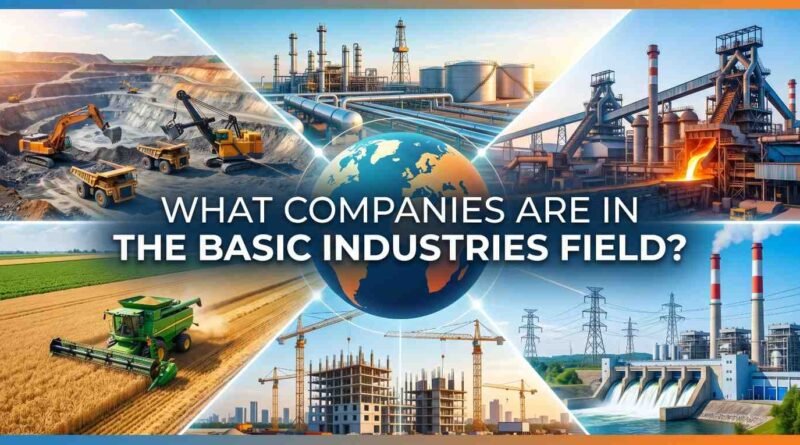
Within the United States, basic industries include metals and steel manufacturing, chemical production, mining and mineral extraction, as well as the extraction of oil and gas, and agribusiness and forest products. These aren’t a few niches. They’re at the heart of what the US has built its economic system on for more than 100 years.
Which Sectors Fall Under Basic Industries in the US?
The primary industry sector in the US includes several key segments:
- Manufacturing of metals and steel
- Production of specialty chemicals as well as chemical products
- Mining (copper, gold, potash, aggregates)
- Gas and oil (upstream extraction and refining)
- Agribusiness and processing of agricultural products
- Paper, lumber, and other wood products
- Construction materials and cement
In terms of stock market terminology in terms of stock market terminology, the majority of these companies are part of the category of Materials in the S&P 500, with parts of the Energy sector also registering on the extraction of raw resources side. The NYSE includes a myriad of industrial stocks that are an accurate gauge of how they think the US manufacturing economy is performing.
What Companies Are in the Basic Industries Field in the United States?
Here’s a breakdown of the main players sector-by-sector.
Steel and Metals Companies
Nucor Corporation
Based in Charlotte, North Carolina, Nucor Corporation is on the smaller side of U.S. steel manufacturers, but is one of the most efficient and largest by tonnage. Because of Nucor’s innovative and efficient production methods, the steel market remains competitive for Nucor. Nucor is a solid industrial portfolio option and has consistently paid more dividends quarter after quarter than any other steel company.
United States Steel Corporation (US Steel)
Located in Pittsburgh, Pennsylvania, the United States Steel Corporation (US Steel) is a longstanding hallmark of the American industry. Considerable competition from around the world, manufacturing at cheaper costs, has diminished US Steel’s market position. US Steel continues to be a major domestic producer employing thousands.
Freeport-McMoRan
Freeport-McMoRan, located in Phoenix, Arizona, is the top gold and copper mining company that has large operations throughout the Americas. As the demand for copper rises through electric vehicles as well as green energy systems, Freeport McMoRan has assets that are becoming increasingly valuable.
Chemical Companies
Dow Inc
Headquartered in Midland, Michigan, Dow Inc. is amongst the largest manufacturing companies in the world. Dow produces specialty chemicals, which are used in personal care products, packaging, and infrastructure, among others, and is an integral holding for many of the S&P 500 Materials sector companies.
DuPont de Nemours
Wilmington, Delaware-based DuPont de Nemours has credited the beginning of American chemicals to the 1800s. After many reorganizations and breakups, DuPont is substantially focused on special chemicals, electronics, and industrial chemicals.
LyondellBasell
With the majority of its operations in Houston, Texas, LyondellBasell is one of the largest chemicals, plastics, and refining companies. It is a major player of large-cap basic materials companies and is frequently referenced as a case study in sector analysis.
Mining and Minerals
Vulcan Materials Company
Vulcan Materials Company is the largest producer of construction aggregates (broken stone, crushed sand, and gravel). Their products are used in every major highway and stadium construction in the US, as well as every commercial construction. They are a very quiet company.
Martin Marietta Materials
Martin Marietta Materials is Vulcan’s main competitor and dominates in the southeastern, central, and mid-Atlantic sections of the US. Together, Vulcan and Martin Marietta represent the US aggregates market.
Newmont Corporation
Denver, Colorado’s Newmont Corporation is one of the biggest gold mining companies, and attracts many investors due to the availability of multiple gold mines, both nationally and internationally. Many investors who prefer stocks in the primary sector of industry, specifically in companies that mine and work with natural resources, have Newmont in their portfolios.
Oil and Gas (Upstream and Extraction)
The extraction of crude oil and natural gas is also a part of the primary sector of industry and stands for the upstream component of gas and oil. Among the top three U.S. Upstream oil and gas extraction companies are Chevron and ExxonMobil. Both have multiple upstream operations that extract, refine, and ultimately sell the crude oil and natural gas to their customers.
ConocoPhillips
As one of the most primary industry-focused oil and gas companies, Houston’s ConocoPhillips is primarily concerned with extraction and production.
Agriculture and Agribusiness
Archer-Daniels-Midland (ADM)
Also falling under the primary industry is ADM, Chicago, Illinois, which is among the giants of global agriculture. As one of the largest processors of soybeans, corn, canola, and wheat, its operations are essential to global food supply chains. ADM will invariably show up whenever the industrial companies of America are discussed.
The Mosaic Company
As America’s primary producer of two of the most common fertilizer components, Mosaic Company plays a critical role in ensuring food affordability in grocery stores.
Lumber and Forestry
Weyerhaeuser Company
Weyerhaeuser Company, with headquarters in Seattle, WA, ranks as one of the world’s largest privately owned timberland companies. Seattle also claims Weyerhaeuser as its largest manufacturing company. The company produces building products, wood products, and cellulose fibers. It is one of the oldest basic industry companies on the NYSE. Weyerhaeuser’s performance correlates directly with the development of housing projects in the United States.
Why Do Basic Industry Companies Matter for the US Economy?
They’re not just irrelevant because they’re the backbone of all other things. Steel production fuels the auto and construction industries. Chemical output is used to feed consumer goods, as well as agriculture and healthcare. Mining provides rare materials and copper that the renewable energy infrastructure operates on.
The Bureau of Labor Statistics regularly examines employment statistics in the fundamental industries since these sectors directly indicate the health of the economy. Millions of Americans are employed in the fields of logistics, manufacturing, transportation, and plant operations that are linked to the basic industry firms. If these industries contract, and layoffs are rapid spread outward. As they expand downstream, companies hire and invest.
Basic industries are more closely connected to US economic policies. The production of steel in the US, for example, has become a trade and national security policy issue in the last few years, as tariffs and manufacturing incentives have changed how firms such as US Steel and Nucor operate and invest.
Is Basic Industries a Good Career Path for 2025?
Yes, I think so, and here’s a straight answer: the basic industries provide something that the service and tech sectors don’t often – physical stability and long-term stability. The need for chemical, steel, copper, and agricultural inputs won’t go away due to a trend in software or market correction.
Basic industries have the tendency to pay higher than average for workers with mid-skills. Logistics coordination, plant operations in the chemical industry, quality assurance, and safety control are in high demand. The majority of large corporations in this field, such as Nucor, Dow, Weyerhaeuser, provide well-defined career pathways, pension plans, and union contracts that offer actual job security.
It is reported that the American Chemistry Council and similar trade associations have reported consistent skills shortages in this industry, and therefore, those with the right skills have leverage. If you’re considering a career in 2025, the basic industry should be considered, particularly as US manufacturing investments increase in recent legislation governing infrastructure.
What Does Basic Industries Include in Stock Market Terms?
In terms of the stock market, basic industries companies typically are included in the Materials sector within the S&P 500 classification. This comprises:
- Chemicals (Dow, DuPont, LyondellBasell)
- Mining and metals (Nucor and Freeport-McMoRan), Newmont)
- Forest products and paper (Weyerhaeuser)
- Building materials (Vulcan Materials, Martin Marietta)
Investors keep an eye on this sector to find opportunities to invest in cyclical value. Basic industry stocks usually increase with the growth of the economy and fall in recessions. However, long-term investors typically benefit from steady yields and a steady demand that is tied to production in the real world.
If you are planning to build an investment portfolio that can last over time, knowing what companies are in the basic industries field in the United States is an excellent base.
The Bottom Line on Basic Industries
Basic industries aren’t getting the attention they merit. While headlines focus on the latest apps or startup valuations, companies such as Nucor, Dow, ADM, and Weyerhaeuser are doing their work to keep the physical economy thriving. They extract it through processing, expand it, and then transport it. The rest of the industry is in the background of what they create.
If you’re seeking a job, the field of employment offers security that no other sector will be able to match by 2025. If you’re an investor, this is an area worth studying before the next cycle of infrastructure increases demand for materials. If you’re just trying to understand what’s happening in the US economy, then the fundamental industries are where the story begins.
The companies listed here won’t be going away anytime soon. Steel will be required for the foreseeable future. Chemicals are always produced. Timber, copper, fertilizer, and aggregates never go out of fashion. This is why this sector is distinct from the rest of the industries; it’s not based on fashion. It’s built on the ground underneath the surface.
Frequently Asked Questions
Q: What companies are in the basic industries field?
The top basic industry companies in the US are DuPont de Nemours, Freeport-McMoRan, Weyerhaeuser, and US Steel. Basic industry companies also include companies in the sectors of Agribusiness, Chemicals, and Lumber. Dow, Inc., ConocoPhillips, Nucor Corporation, Vulcan Materials, and the Newmont Corporation are also examples of basic industry companies.
Q: What is considered a basic industry?
Basic industry is the extraction and processing sector. It transforms raw materials into intermediate goods for other industries. This involves lumber, agri-products, mining, and oil and gas processing.
Q: Is basic industries a good career path?
Basic industries have benefits and career growth opportunities to potentially pursue a job in manufacturing, engineering, or even logistics. Furthermore, it has one of the most consistent job demands out of all industries. The benefits are good, and most companies provide a welcoming framework for unions.
Q: Which sectors fall under basic industries in the US?
Basic industries of the US are primarily Agribusiness, Oil and Gas, and Mining and Minerals. These industries are a part of the S&P 500 in the Energy and Materials sectors.
Q: What does basic industries include in stock market terms?
In stock market terminology, the basic industries companies are part of the S&P 500 Materials sector. Basic industries companies include mining and construction aggregates, as well as other companies on the NYSE and other stock exchanges, like Woods and Agricultural Processing, Lumber, and Chemicals.
Q: What is an example of a basic industry company in the US?
Nucor Corporation is a great example of a basic industry company. Nucor is one of the largest U.S. steel producers, is publicly traded, makes a profit every year, and is a good example of a basic industry company that supports further production throughout the country.
If you want timely breakdowns of the trends and businesses that define the industries in the U.S. economy, USA Times Square is for you! We simplify the business market, the industry, and the information with no jargon. Just raw information. Simple, plain, and honest English is the backbone of our site! Bookmarking USA Times Square will allow you to find our sector guides and company spotlights with investment explainers that will help you understand the fundamentals of the American economy, as well as the market trends.