
Spain Deports Thousands of Ceuta Migrants as Italy Tightens Borders Amid Growing Crisis
The sudden, massive influx of migrants from Morocco to Spain’s North African territory, Ceuta, sparked a diplomatic crisis in Europe. Spain is deporting those migrants who have entered illegally after an estimated 50 000 people attempted the crossing within a few days. Meanwhile, Italy has taken a unique step by temporarily suspending some parts of the borderless Schengen Agreement it has with Spain, a move that has sparked a political backlash.
This is a complete, factual account of the events, the deaths, and the way the crisis has reshaped tensions in the region.
Ceuta: What happened?
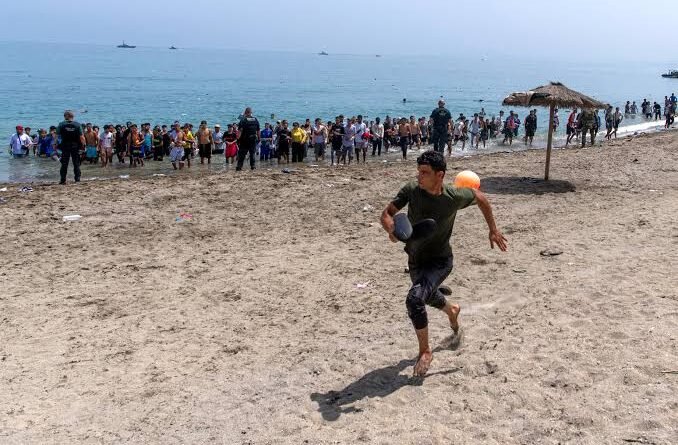
Tens of thousands attempted to cross the border from Morocco into Ceuta. Ceuta is a small Spanish colony on Africa’s north coast, with an estimated population of 84,000. Authorities described scenes of chaos as thousands of people flooded the border on land and by sea. Spanish officials claim that the surge in migrants has reversed and most have returned to Morocco on Friday night.
As the situation develops, the reported death toll varies by source. Some outlets report at least 18 while others say as many as 57. Authorities claim that many of those who died drowned in an attempt to cross by sea. Violence was also reported in the Moroccan border town of Fnideq.
Spain’s response
The Spanish Prime Minister Pedro Sanchez travelled directly to Ceuta when the crisis began. Authorities say they want to remove those who have entered illegally from the country as soon as possible. However, a recent ruling by Spain’s Supreme Court states that migrants arriving via sea cannot be sent back to Morocco. This has created legal uncertainty about how to proceed with deportations for some.
Why Italy suspended Schengen with Spain
Italy responded to the crisis by announcing that it would temporarily suspend Schengen borderless travel arrangements with Spain. This suspension will last for 30 days and restore passport checks for those traveling between the two countries via air or sea. Italy does not share a land boundary with Spain. Therefore, the move only affects air and ferry travel.
Antonio Tajani, Italian Foreign Minister and Vice Prime Minister, framed this decision as necessary for the protection of European borders and citizens’ safety. Italy said that it coordinated with France in order to increase checks at the Franco-Italian border to stop undocumented migrants moving into Europe.
The Move Has Attracted Political Reaction
It has been criticized by opponents of the right-wing coalition led by Italian Prime Minister Giorgia Meloni, who dismiss it as a symbolic gesture meant for domestic audiences. They claim that there is no evidence to suggest migrants crossing into Ceuta specifically wanted to get to Italy. The government has also been accused by critics on the centre-left of bowing to the pressure from the new far-right party, led by ex-army general Roberto Vannacci. His anti-immigration remarks have gained popularity with some voters.
Why this keeps happening: the Morocco-Spain dynamic
Ceuta is not the first place to see a mass crossing. A similar incident happened in May 2021 when 8,000 people rushed across after Moroccan authorities seemed to relax border controls for a few days. This incident was linked to the diplomatic tensions between Madrid and Rabat regarding Western Sahara.
Morocco refers to centuries-old Spanish territory as “occupied” and does not recognize Spanish sovereignty. Analysts have questioned whether Moroccan border officials may have intentionally eased enforcement of the law during this recent surge. However, this is speculative as neither government has confirmed it.
What’s Next?
The crisis, which began as a Spain-Morocco bilateral issue, has now escalated into a debate about border security in Europe. France is also ordering additional border checks. Italy will suspend Schengen for 30 days. The speed of the situation’s stabilization will depend on how Spain handles its Supreme Court decision regarding deportations at sea and whether tensions between Spain and Morocco are eased.
FAQs
How many migrants have crossed into Ceuta in the last year?
According to Spanish authorities, an estimated 50,000 people have attempted the crossing from Morocco. However, most have returned of their own volition.
Why did Italy suspend Schengen agreements with Spain?
Italy has temporarily reinstated passport checks for air and sea travel out of Spain, citing the Ceuta surge as a concern.
How many people have died at the Ceuta border crossing?
The reported death tolls are different depending on the source. They range from 18 to 57. Drowning is cited as one of the leading causes.
Can Spain expel all migrants who cross?
A recent Spanish Supreme Court decision states that migrants arriving via sea cannot be sent back to Morocco. This complicates deportation attempts.
Does Italy have a land border with Spain?
The Schengen suspension affects only air and maritime travel between the two countries.
Why does Morocco contest Spain’s control over Ceuta?
Morocco has long referred to Ceuta and Melilla as occupied territory, which is a source of diplomatic tensions between the two nations.
Final Thoughts
This rapid-fire crisis has revealed both the fragility and tensions of the Schengen system and the unresolved issues between Spain and Morocco regarding the status of Ceuta. USA Times Square will provide updates on the situation as it develops.