
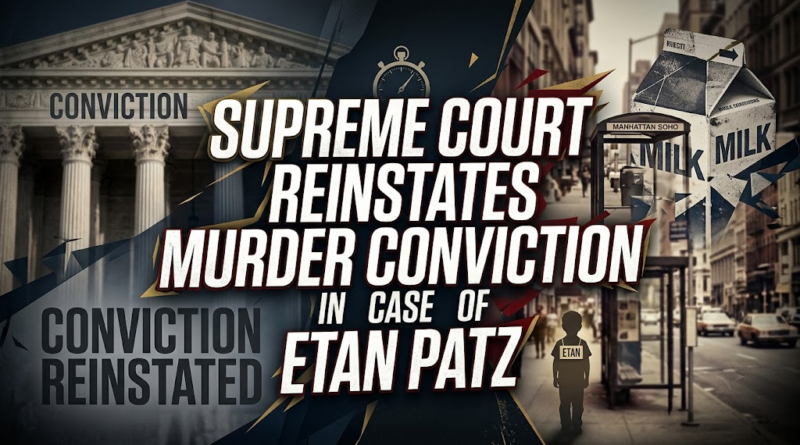
Supreme Court Reinstates Murder Conviction in Case of Etan Patz
The Supreme Court of the United States has overturned an earlier decision by the United States Court of Appeals in the Ninth Circuit to overturn a murder conviction for Pedro Hernandez in the infamous 1979 disappearance of 6-year-old Etan Patz.
The Supreme Court overturned a previous federal appeals court ruling that had found the defendant not guilty, in an unsigned 6-3 decision that was backed by a conservative majority. The high court ruling puts an end to a languidly drawn legal battle over one of the most celebrated missing-child cases in the history of the United States.
Background of the Etan Patz Case
Etan Patz was first reported missing on May 25, 1979, when the six-year-old boy walked alone to the bus stop at his school in Manhattan’s SOHO neighborhood.
Patz was among the first missing children whose faces were used to generate investigative leads by being featured on the sides of milk cartons as a National Symbol. National Missing Children’s Day is still celebrated every year at the time of his disappearance.
The Suspect: In 2012, when investigators received a tip, they determined Pedro Hernandez was a suspect, even though the body of the boy was never recovered. At the time of the disappearance, an 18-year-old Hernandez worked at a convenience bodega near the boy’s bus stop.
Hernandez then confessed to police that he had pulled Patz into the basement of the store, strangled him, and then dumped his body in an alley nearby.
The Legal Battle and Supreme Court Ruling
Now 64, Pedro Hernandez has already been tried on two separate charges by the state court. The first trial in 2015 was a mistrial after a tie in the jury box. In a 2017 retrial, another panel convicted him of kidnapping and murder, sentencing him to 25 years to life imprisonment.
The Appeals Court Overturned
The U.S. Court of Appeals for the Second Circuit overturned the conviction. The appellate judges found that the trial judge had provided a “manifestly prejudicial” answer to an important jury question that emerged in the 2017 deliberations.
If jurors determined Hernandez’s confession, before being read his Miranda rights, was coerced, they were asked if they should ignore the later videotaped confessions. The trial judge merely answered, “No, the answer is no! The Second Circuit stated that the jury should have been given a better explanation, with the potential to disregard any later confessions.
The Supreme Court’s Decision
The Supreme Court directly dismissed the Second Circuit’s action, saying that the federal appeals court had exceeded its jurisdiction under a 1996 federal statute aimed at curbing federal court meddling in state criminal convictions.
In the unsigned majority opinion, the justices said that the Second Circuit “erred in granting relief to Hernandez.
The three liberal justices in the court, Sonya Sotomayor, Elena Kagan, and Ketanji Brown Jackson, dissented. New York prosecutors were already planning to take Hernandez to trial in September before his triple murder conviction was overturned on Monday.
Reactions From Both Sides
Attorney General Bragg for the City of New York said the verdict was a positive one, and his office has been “a voice of reason and support” throughout the process.
In an official statement, Bragg said the Supreme Court affirmed “the findings of numerous lower courts” and affirmed “the trial conviction of Pedro Hernandez for the horrific murder of Etan Patz, which changed a generation of New Yorkers.
On the other hand, Hernandez’s defense attorneys, Harvey Fishbein and Alice Fontier, were “dissatisfied. Defense has long held that Hernandez is innocent and had been suffering from a mental illness that led him to falsely confess and hallucinate afterwards after being subjected to a seven-hour interrogation before being read his rights by police.
Hernandez was convicted, and he is still incarcerated at the Elmira Correctional Facility in New York, where he will be eligible to be released on parole in 2037.
Frequently Asked Questions (FAQs)
What caused the initial conviction to be reversed?
The 2017 verdict was overturned by the federal appeals court because it concluded that the trial judge’s “no” answer to a complicated question asked by the jury on the issue of how to handle recorded confessions after a preliminary, non-Mirandized one was made was misleading.
On what grounds did the Supreme Court reinstate the verdict?
Under a federal statute enacted in 1996, federal habeas courts have no authority to re-evaluate the reliability of evidence or the specifics of a state-court trial, and were not allowed to do so in this case.
Was Etan Patz’s body ever recovered?
The authorities never found the body of Etan Patz. Much of the conviction was based on confessions given inside and circumstantial evidence introduced at the state trial, which lasted five months.
Keep up-to-date on new case law.
The case of Etan Patz is historic in criminal justice history and appellate court jurisdiction in the USA.
Follow our USA Times Square lifestyle and news blog for further deep dives into great cultural moments, legal news updates, and thorough historical deep dives.