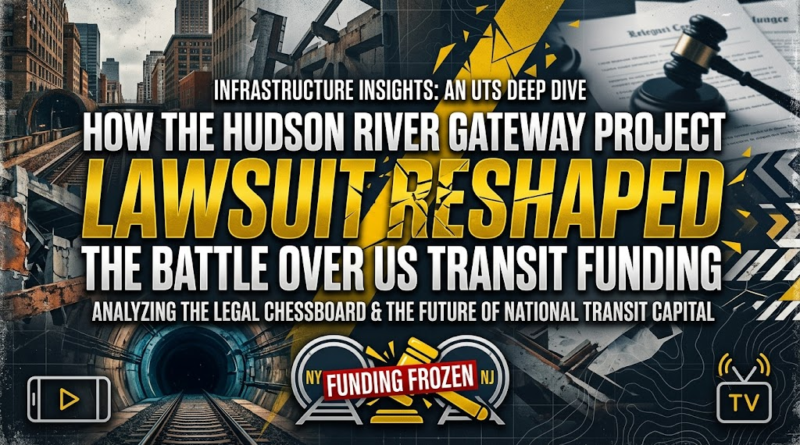
How the Hudson River Gateway Project Lawsuit Reshaped the Battle Over US Transit Funding
The national debate on infrastructure financing is at a pivotal moment. At the level of massive infrastructure, few projects could be as vital to the American economy as the Hudson Tunnel Project. This massive megaproject is an important route for both Amtrak and NJ Transit, tasked with revamping the century-old storm-damaged rail tubes that link New York with New Jersey. But by late 2025, that same essential engineering endeavor will have become the hot-button flash point for a high-stakes constitutional war.
The sudden executive action threatened to stop construction altogether, sparking the Gateway Tunnel funding lawsuit. The legal battle that ensued not only changed the history of a regional rail line but redefined the basis on which federal transportation dollars are raised, safeguarded, and allocated in the United States.
The Freeze: What’s the Hudson Tunnel Project Lawsuit about?
It’s important to go back to the unpredictable executive moves made by the Trump administration in late September of 2025. The federal government and its budget officials under White House direction, along with the DOT, imposed an aggressive Hudson Tunnel Project funding freeze, which stopped disbursements that had been made under contract.
Gateway Hudson Tunnel Project Blueprint
- Total Project Estimated Cost: $16 Billion
- Federal Grant/Loan Commitment: $12 Billion
- State/Port Authority Financing: $4 Billion
- Job Impact of Executive Freeze: ~1,000 workers sidelined immediately
The Stated Reason: The DEI Directives
In an official justification of the US Department of Transportation funding withheld, it was stated that this was due to an internal compliance review. The administration had concerns that the spending blueprint for the project was based on “unconstitutional diversity, equity, and inclusion (DEI) principles,” said White House budget director Russ Vought on social media, focusing on the project’s federally mandated Disadvantaged Business Enterprise (DBE) programs.
The Real Catalyst: Political Leverages
A parallel public story told of the federal lawyers coming to audit discriminatory contracting practices, while the reality was quite different. President Donald Trump publicly bragged on social media about canceling the multi-billion-dollar project, explaining the funding block as a direct political weapon against key East Coast Democrats.
The rapid shutdown trapped the Gateway Development Commission in a no-win situation. The commission already has reached the limits of its available lines of credit to continue construction and warned that if it was not relieved soon, it would be forced to cancel large, multi-year construction contracts for convenience.
The Legal Counteroffensive: New York and New Jersey Sue Trump Gateway
Local government responded immediately to a situation of an imminent Hudson Tunnel Project shutdown and the loss of over 1000 construction workers in one week. On February 3, 2026, New York Attorney General Letitia James and New Jersey Acting Attorney General Jennifer Davenport filed a joint lawsuit in the U.S. District Court for the Southern District of New York. At the same time, the Gateway Development Commission filed a counterclaim in the U.S. Court of Federal Claims.
The states’ rail tunnel lawsuit labeled the executive action “arbitrary, capricious and flagrantly unlawful” in an effort “to punish political rivals” by using “congressionally approved” infrastructure expenditures.
Whether the sitting Presidential Administration has the authority to retroactively block billions in grants authorized by Congress in specific legislation from previous packages, like the 2021 Infrastructure Investment and Jobs Act, was the simple yet profound question before the court.
Did Gateway Tunnel Funding Get Restored?
The quickness of the legal resolution was unprecedented because of the great economic dangers involved.
In February 2026, U.S. District Judge Jeannette Vargas issued an emergency temporary restraining order finding that the “sudden suspension” caused “immediate and particularized harm to the public safety and regional infrastructure. This was an initial order that triggered an immediate demand for cash flow for the federal government, which enabled crews to return to job sites.
On June 29, 2026, Judge Vargas issued a 59-page, final, permanent ruling that permanently prohibits the administration from ever freezing these infrastructure grants again.
The court, in a scathing ruling, essentially admitted the illegality of the freeze by the federal government. Judge Vargas cited the administration’s public statements and ruled that it was simply a way to get around an arbitrary political move and was directly in violation of the Administrative Procedure Act because of its DEI rationale.
The Broad Impact on US Transit Funding Lawsuit 2026 Dynamics
This historic settlement in the landmark US transit funding lawsuit of 2026 has far-reaching implications beyond New York and New Jersey. This case successfully overthrew the move by the executive branch to try to claw back or freeze in place transit agency award money for ongoing projects, leaving a giant legal barrier in place for agencies across the country.
Reinforcing “Grant Certainty”
Before this case, municipalities and state transportation agencies were concerned that a change in the political climate in Washington would leave them on the hook for multi-billion-dollar megaprojects that were in the throes of construction. The permanent injunction is very harsh for infrastructure capital that is used as a legislative weapon of coercion, and makes it clear that if a federal Full Funding Grant Agreement (FFGA) is signed, it must be kept.
A New Legislative Fault Line
The vote has turned the tide in the debate over the next big U.S. surface transportation bill. Now, lawmakers are scrambling to impose strict statutes that will permanently ban any future administration from canceling, rescinding, or redirecting money that has been signed into contract with local transit.
Frequently Asked Questions (FAQs)
Why did Trump freeze funding for the Gateway tunnel?
The administration officially said it had to review and audit the project’s Disadvantaged Business Enterprise (DBE) policies to determine if they were in conflict with its federal position on DEI. But the federal court ruled the comments were made in public at the time by the executive branch, indicating it was an arbitrary political decision made to target local politicians.
What is the total amount of federal money owed tothe Gateway project?
All the project depends on is roughly $12 billion in federal grants and special loans for transit and a total cost of $16 billion. The remaining $4 billion is fully funded by local commitments from New York, New Jersey, and the Port Authority.
Is construction on the Hudson Tunnel currently moving forward?
Yes. With the permanent court order issued in June 2026, all federal grant disbursements are now guaranteed. Extensively specialized tunnel boring machines are in operation,n and the project continues to be on its wider target trajectory to complete the project by 2035.
Roadmap to the Nation’s Future of Infrastructure
The Gateway infrastructure fight has been resolved, and this demonstrates that there will be politics as long as there is politics, but the literal bedrock of American transit, however, cannot be sacrificed for short-term political gain.
Be sure to bookmark the USA Times Square analytical home page to get the latest scoop on breaking political news, historic federal court decisions, and in-depth economic analyses of our nation, every day.