
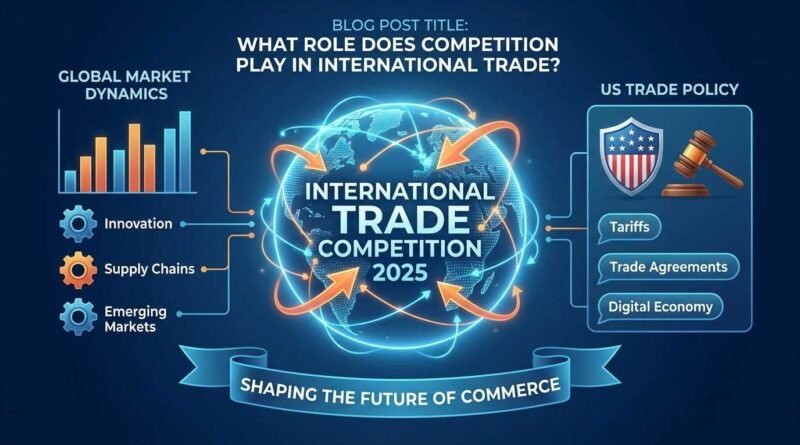
What Role Does Competition Play in International Trade?
In 2026, international trade competition will change the way countries buy, negotiate, and sell on the global stage. If you have ever wondered why the price of your groceries changes when tariffs change, or why American producers struggle to compete with cheaper imports, then competition is almost always the answer.
This is not just a concept from an economics book. Global competition affects everything from jobs in Ohio to prices at Walmart and trade agreements signed in Geneva. You should understand trade news because it affects your life, whether you are a follower or not.
Break it down.
What Is Competition in International Trade?
International trade has the elements of a highly competitive marketplace. Trade across borders requires countries and businesses to deliver the best products and offer the most competitive pricing and optimum delivery times. Think of an auction that never ends. But in this auction, the USA, Germany, China, Japan, Mexico, and many others are selling to the same buyer.
This relentless competition relies on the principle of comparative advantage that economists speak of, where countries are advised to produce their most efficient products and trade the rest. The USA is a dominant player in the exports of agriculture, aerospace, and financial services. Bangladesh has a dominant position in the trade of garments. With these countries doing what they do best, they can trade with each other. This is the best kind of competition.
Unfortunately, real-life trade competition is not that perfect.
How Does Competition Affect Trade Between Countries?
Theoretically, competition between countries can drive down prices and improve quality. Nike moved production to Vietnam when it could produce sneakers for less than in American factories. This puts pressure on US manufacturers, forcing them to cut costs, automate, or focus on higher-valued products.
Global supply chains are a result of this. Apple does not manufacture all its products in one place. Apple sources chips in Taiwan, assembles them in China, distributes worldwide, and reports its profits in the US. Each step in the chain is a competition between suppliers to get the best price.
This competition has historically led to lower prices for American consumers. The US trade deficit, which is a result of importing more goods than they export, is a reflection, in part, of how global competition has made foreign products cheaper than domestic alternatives in many categories.
It’s not all good. Losing that competitive advantage to countries with lower wages has had a negative impact on communities that are tied to the steel, textiles, or auto industries. US trade policy has been wrestling with the tension between national competitiveness and local job security for decades.
Why Is Competition Important in Global Markets?
Monopolies are inevitable without competition. A country or bloc that controls an important resource, such as rare earth minerals or crude oil, can set the price without any opposition. The World Trade Organization was created in 1995 to establish a system based on rules that would keep international trade fair and competitive.
The importance of global competition is important for many reasons.
- This keeps the prices down. Buyers have more options when multiple countries are producing the same product. The availability of options creates price pressure that is beneficial to both importers and customers.
- Innovation is a result of this. South Korean companies such as Samsung did not dominate the electronics market by accident. They invested in R&D and competed fiercely to beat their rivals. This pressure drives every player to improve.
- This creates interdependence. Conflicts become more costly when countries depend on each other to trade. It is for this reason that economists and diplomats argue that free trade promotes peace, even though the theory has been put to the test in the post-2018 era of trade wars.
- It is efficient in allocating resources. Businesses and governments are able to identify where real opportunities and demand lie. Those countries that grow their export sector are those that respond well.
How Do Tariffs Affect International Competition?
Tariffs act as taxes on imports and directly affect the competition. The US steel industry becomes more competitive in the US when it applies a 25% tax on Chinese steel. Local producers gain. Steel is expensive for companies that use it to make cars and appliances. This can increase their costs, which will ultimately affect your prices.
In 2026, the US trade policy will continue many of the tariffs introduced by the Trump administration during its first and second terms. The Biden administration continued to maintain a variety of tariffs on Chinese products, and the current political climate continues the use of tariffs both as a revenue tool and a competitive shield.
What is the problem? Tariffs may trigger retaliation. China’s response included its own tariffs on American soybeans. This directly affected Midwest farmers. This is the result of manipulating competition by using trade barriers.
Trade agreements such as the USMCA (United States, Mexico, and Canada Agreement) are designed to promote fair competition within a group by reducing tariffs between members. Each country is still allowed to compete in an open manner. Similar rules govern the European Union’s single market.
How Does Competition Shape US Exports and Imports?
The competitiveness of America’s exports depends on some factors, including the strength of its dollar, the domestic production costs, the innovation capacity, and the trade policy of partner countries.
When the dollar is high, US goods are more expensive abroad. This makes American goods less competitive in the global market and can slow down export growth. US products become more appealing on the international market when it falls.
US exports in 2026 will remain strong, especially in areas such as software, entertainment, finance, and education. These are all fields where American companies excel. Exports of manufacturing products like aircraft (Boeing), agricultural commodities (corns, soybeans, and wheat), and medical equipment were also competitive on global markets.
The US continues to import large quantities of electronics, vehicles, pharmaceuticals, and consumer goods from China, Mexico, and other countries. This is the result of competition, with foreign producers often outperforming US domestic alternatives in terms of cost, quality, and sometimes both.
Does Free Trade Always Mean Fair Competition?
Not automatically. According to the free trade theory, removing barriers will allow the most efficient producers to win and, over time, this will raise living standards worldwide. Critics, from labor unions and national security experts to economists, say that free trade can be exploited.
Currency manipulation is an example. A country’s exports will become cheaper worldwide if it artificially deflates its currency. This is without any improvement in efficiency. This is not a competitive advantage. It’s a subsidy that distorts the market.
State-owned companies in countries such as China are able to absorb losses that private businesses cannot, and can undercut competitors for many years before they become dominant. The US has repeatedly raised this concern at the WTO in relation to Chinese industrial policy.
It’s not a new debate, but the volume is higher than in previous decades. It usually boils down to who makes the rules and whether or not the major players are willing to follow them.
What Does Competition Mean for Everyday Americans?
The practical side. For decades, international competition has kept prices low for everything from smartphones to clothing to furniture. Economic globalization, which accelerated in the 1990s and was accelerated in 2001 by China’s WTO entry, has pushed down prices, directly benefiting American households.
It also devastated the manufacturing towns. Global competition, which moved production outside the US, made the industries of Detroit, Youngstown, and Gary shrink. Tariffs, trade barriers, and “buy American” policies are political reactions to this. They are a reflection of the real pain and are not mere rhetoric.
Currently, the US is trying to protect important sectors needed for the economy and national security, while trying to remain as open as possible to international markets. Washington is trying to strengthen the US’s international competitiveness in semiconductors, electric vehicle battery production, and pharmaceuticals.
FAQs
Q: What role does competition play in international trade and economics?
Good competition means good business. Businesses must continuously upgrade and better their product offerings to stay relevant and win customer loyalty even in other countries. Healthy competition is necessary for the advancement of trade, better prices for consumers, and improvements within the sectors in which a business exports.
Q: How does competition affect trade between countries?
Competition requires good business practice to cut costs and maintain quality. Countries that can competitively participate in the global market successfully increase their export income. Countries that are unable to do so usually lose industries to competitors and have trade deficits.
Q: Why is competition important in global markets?
Producers will take advantage of the absence of competition to raise prices and reduce quality. It creates a new normal for honest production practices. Competition helps consumers, importers, and the world economy.
Q: How do tariffs affect international competition?
Tariffs create advantages for local producers by making imports more expensive. This will force producers to operate better to remain relevant. Tariffs create an inverse relationship throughout the economy because they shield inefficiencies, thus increasing the cost of production inputs.
Q: Is free trade always fair trade?
No. Fair free trade occurs when there is a level playing field for all trade participants. In most cases, free trade can be distorted through practices like subsidy dumping, currency manipulation, and the implementation of state monopolies.
Q: How does global competition affect US consumers?
Global competition creates easier access to cheaper imports and introduces a wider variety of choices, leading to lower prices and better quality goods for consumers. The flipside is that goods producers will lose jobs to imports of cheaper goods. This potential loss of domestic goods drives the politicians to form protective trade policies.
Take Away
Don’t sleep on the trade policies that impact your economy. The US trade policy climate will change rapidly in 2026 and beyond. It will affect everyone from business owners and investors to students and the average consumer, trying to make sense of the fickle prices. Understanding the effect of international trade on competition is essential.
Read economic and trade analysis at USA Times Square. We touch on topics that impact the market and policy affecting your life, presented in an accessible fashion, free of complex terminology.