
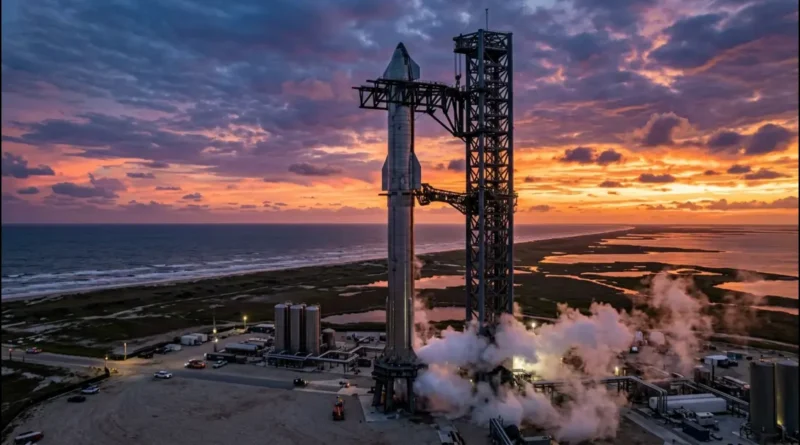
SpaceX Starship Flight 13 Launch Countdown Begins
SpaceX Starship Flight 13 launch countdown SpaceX Starship Flight 13 launch countdown was at its end on July 16, 2014, and an automatic stop signaled the entire mission off. A large number of people who watched from the beach near Starbase, as well as livestream viewers across the globe, saw the largest rocket ever constructed sit completely fuelled on the pad, but the spacecraft’s own flight computer took over at T-0 and shut it down. This was a significant moment for SpaceX. This was the initial Starship test since its debut on the stock exchange in June. Wall Street was watching right along with space people. The scrub isn’t the end of the tale, however. This is a break before the next attempt, as there’s plenty on the line: the success of getting Flight 13 off the ground.
What Happened During the SpaceX Starship Flight 13 Launch Countdown?
The countdown was flawless until the last second, and then onboard computers detected that a few parts of the Super Heavy booster’s engines hadn’t started, and they called a stop. SpaceX has opened the 90-minute launch window at 6:45 p.m. EDT (2245 GMT) on July 16 from Pad 2 at Starbase, Texas. The Booster 20, along with Ship 40, had been rolled out and stacked a few days before, in the wake of static fire tests for the Raptor 3 engines. SpaceX provided a “go” call for propellant loading about an hour before the window opened, and the weather was good all afternoon. At ignition, the abort signal was received. Elon Musk posted on social media around ten minutes later that some engines were unable to start and set off an auto-launch abort. The crews were then working to remove propellant from the car.
What Caused the Launch Abort?
The four Super Heavy boosters’ 33 Raptor 3 engines didn’t start in the manner they were intended to, and then the automated safety system intervened to prevent a disastrous liftoff. This is precisely the kind of check that Starship’s built-in flight computer is built to conduct, and in this instance, it performed as planned. Musk posted on his social media accounts that it was believed that 2 of the rocket’s Raptor engines must be replaced prior to SpaceX’s attempts to fly again, and he called it the best way to guarantee the cleanest flight. The removal and replacement of engines on a rocket that size is a lengthy process and is the reason the date for the next flight wasn’t set at the time of writing.
When Will SpaceX Try the Starship Flight 13 Launch Again?
The most likely date will be in early next week, according to Musk’s announcement on the day following the scrub, even though SpaceX hasn’t announced a specific date as of yet. This timeline is in line with the speed with which SpaceX has turned around its previous scrubs, given that engine changes in Starship are a routine component of the process before launch at the moment. One obstacle has been cleared: SpaceX has already received the Federal Aviation Administration’s approval to close its investigation into the crash of Flight 12 on July 13 and accepted SpaceX’s findings, which was what permitted Flight 13 preparations to proceed initially. This regulatory sign-off is still in effect, so the only remaining task is to complete the engine and run a countdown. After the swapped Raptors are cleared by their own inspections and can pass their own checks, anticipate seeing the SpaceX Starship Flight 13 launch rescheduled for a new launch date in the next few days instead of weeks, considering that both the rocket and the ground components have already gone fully counted this week.
What Is Starship Flight 13 Supposed to Accomplish?
Flight 13’s main task is to test fixes made on the previous flight while delivering the actual equipment into space for the very first time. This includes twenty production Starlink V3 satellites. The second flight of the improved Starship V3 vehicle follows its launch with Flight 12 back in May. On the side of the booster, Super Heavy is set to manage ascent, stage separation, and a boostback fire, and a landing burn that will conclude with controlled splashdown on an offshore spot within the Gulf of Mexico. The two aircraft, Booster 20 and Ship 40, are flying for the first time, and neither one is being salvaged to be reused on this mission. From the side of the ship, the goals include relighting one Raptor engine in space and then completing a controlled reentry that ends by splashing down in the Indian Ocean. It is expected that the Starlink V3 satellites are on board and will expand their antennas and solar arrays and try to establish a short connection to the ground station located in South Africa and the broader Starlink network. Six of the satellites have cameras that are designed to scan Starship’s heating shield, and SpaceX painted a few tiles white to act as tracking targets to mimic the absence of tile coverage. All of these satellites are designed to achieve the stability of an orbit during this flight because they move around on Starship’s suborbital trajectory and then return within minutes of dissociating the satellites; however, a successful deployment and a brief handshake with the network would be considered a significant event of Starship’s 13th flight, as well as for the larger Starlink V3 rollout.
How Does Flight 13 Build on Flight 12’s Results?
Flight 12 flew on May 22, 2026. It was the launch of SpaceX’s V3 vehicle. Although SpaceX said it was mostly successful, it left SpaceX with a clear checklist of tasks. An alteration to the sequence of ignition in the hot stage, a sequence where the Ship’s engines start firing before the two halves fully separating, resulted in Super Heavy tumbling into an error in orientation of 90 degrees after the separation. The boostback burn was ended as five of its engines failed to light, which meant that the booster did not reach its gentle splashdown area within the Gulf. On top, the Ship’s three vacuum-optimized Raptor engines failed to ignite around 40 seconds after the stage separated. SpaceX states that it developed an array of improvements in preparation for Flight 13 based on that review, and is making the Ship more capable of handling more structural load when it reenters and ascends this time. Engineers modified the hot stage ignition timing, rearranged the sequence of relighting engines for boostback, and also made tweaks to the hardware targeted at both of the issues, all without ever getting to the ignition issue that ultimately scuffed the July 16 launch. Each of these solutions will need to be proven after Flight 13 actually gets off the runway.
Where Does the Rocket Launch From, and How Big Is It?
Every Starship test, including Flight 13, lifts off from Pad 2 at SpaceX’s Starbase facility close to Boca Chica Beach in South Texas. Together, Super Heavy and Starship measure 124 meters, which is about 408 feet tall, and measure 9 meters in width. The Super Heavy’s 33 Raptor 3 engines are rated to generate around 80,800 kilograms of combined liftoff thrust, which is nearly 18 million pounds. Between the two levels, the vehicle will contain more than 5,000 metric tonnes, which is about 11 million lbs, of super-cold methane liquid as well as liquid oxygen. The longer-term goal is that SpaceX will create Super Heavy and Ship to Ship Super Heavy and Ship Super Heavy to fly back to the launch site. Then the tower’s chopstick-like arms, known as Mechazilla, will catch them out of the air instead of landing on legs similar to Falcon 9. Flight 13 does not skip that stage, as both of them are heading to the ocean instead.
How Can You Watch the Starship Flight 13 Launch?
SpaceX broadcasts each Starship launch attempt at no cost on their website as well as the account it has on X, typically starting about 30 minutes before the launch window opens. Outlets that report on space and the space beat, including Space.com and Spaceflight Now, mirror that same feed, but with additional commentary and mission information. Beach and road closures around Starbase, as well as Boca Chic, typically begin hours before the window is opened. Hence, those who plan to view the launch live from the South Texas coast should check closure notices for the county ahead of time, rather than assuming access. Cameron County typically posts the latest closure notices within a few days of an official launch date. However, those times can be altered if SpaceX alters the timer to coincide with weather conditions or hardware checks.
Why Does This Launch Matter for SpaceX’s Future?
The Starship’s performance will determine how fast SpaceX will expand the Starlink constellation and fly larger cargo, and ultimately support NASA’s plan to land astronauts on the Moon. The rocket is at the heart of the future Generation of Starlink satellites as well as NASA’s Human Landing System work for the Artemis program. So each flight test directly feeds into the larger objectives. This particular flight test came under particular scrutiny as it marked the only Starship flight test after SpaceX’s launch in June. Investors were aware of the scrub, and the shares plummeted over 3% during after-hours trading following the failure and capped off an already poor trading day for SpaceX’s stock. This kind of reaction is a new horizon for SpaceX, which spent more than two decades as a private company that ran test flights with no stock price to pay. Every countdown now has an audience from the financial side as well as the technical side, and a smooth SpaceX Starship Flight 13 launch will go a long way towards calming investor anxiety after an unsettling first month of trading on the public market.
The Road Ahead for Flight 13
Indeed, the SpaceX Starship Flight 13 launch was not successful at first; however, a scramble caused by two engines that aren’t working can be rectified and is not a setback to the larger goals of the program. SpaceX has already passed its regulatory hurdles, and piled the real Starlink V3 hardware onto the Ship and identified the issues that need to be addressed before its next countdown. With Musk suggesting that it will happen in this week’s launch, SpaceX’s next mission will be swift when the engine swap wraps up. In the meantime, Starbase stays on standby until an upcoming launch window determines the fate of Flight 13.
Frequently Asked Questions
What is SpaceX Starship Flight 13?
The 13th test flight of SpaceX’s Starship and Super Heavy rocket system, and the second flight of the V3 upgraded vehicle since the launch in May 2026.
What was the reason for this Starship Flight 13 launch scrub?
The flight computer initiated an automatic stop at T-0 when four Super Heavy boosters’ 33 Raptor engines failed to ignite properly.
When will the following Starship Flight 13 launch attempt be?
SpaceX hasn’t announced a definitive date; however, Elon Musk stated that the beginning of this week would be the most likely date once two Raptor engines are replaced.
Where will Starship Flight 13 launch from?
The mission starts at Pad 2 at SpaceX’s Starbase facility in proximity to Boca Chica Beach in South Texas.
What is it that Starship Flight 13 carries into space?
The Ship is loaded with 20 of the manufacturing Starlink V3 satellites, the first batch of this upgraded design that will fly aboard Starship.
What can I do to watch Starship Flight 13 live?
SpaceX streams both the countdown and the flight at no cost on their website as well as their X account. Typically, the countdown begins approximately 30 minutes before the launch window begins.
Are you waiting for an update on the upcoming Starship Flight 13 launch as soon as it is announced? Follow us at USA Times Square for the most recent information about the countdown as well as the launch window, and everything SpaceX is doing next.